LLM Integration in Montreal: Wiring an LLM Into a Real Product, Safely
How to add a large language model to a real product in Montreal: architecture, prompt injection defences, bilingual French-English output, Law 25 and costs.

Montreal is unusual among the markets we serve. Thanks to the research cluster around Mile-Ex and the city's game studios, product teams here often understand language models better than the vendors pitching to them. What they need is not an explanation of transformers. It is the unglamorous production engineering that turns a model call into a feature customers can rely on, in French and English, without leaking data or running up a surprise bill.
This is how we wire an LLM into a real product.
The model call is the smallest part
In a typical first integration, the code that calls the model is around a tenth of the effort. The rest is getting the right context to the model with permissions enforced, testing whether answers are good, defending against misuse, handling failures gracefully, and controlling cost.
Teams that start with the model call and add the rest later usually rebuild the feature.
Architecture: put a gateway in the middle
We route every model call through a small internal gateway rather than calling providers directly from application code. It gives you:
- One place to switch providers or models when quality, price or policy changes.
- Consistent logging of prompt version, model version, latency and cost, with personal data redacted.
- Budgets and rate limits per feature, team or customer.
- Retries and fallbacks, including a non-AI fallback when the model is unavailable.
The feature code asks the gateway for a result; it does not care which model produced it.
Context with permissions enforced
Most useful LLM features need your data: records, documents, tickets, product information. The critical rule is that permissions are enforced before the model sees anything. Retrieve only what the current user is allowed to access. Filtering the model's answer afterwards is too late, because the restricted content has already shaped the response.
Prompt injection is the top risk
The OWASP Top 10 for LLM Applications puts prompt injection first, and for good reason. Any text the model reads, whether a user message, an uploaded file, an email or a web page, can contain instructions that override yours.
Defences that work in practice:
- Treat all external content as untrusted data, never as instructions.
- Limit tools: the model can only call narrow, validated functions.
- Separate read and write: anything that changes data needs explicit confirmation.
- Validate outputs against a schema before using them.
- Test with adversarial examples in the evaluation set.
Bilingual by design
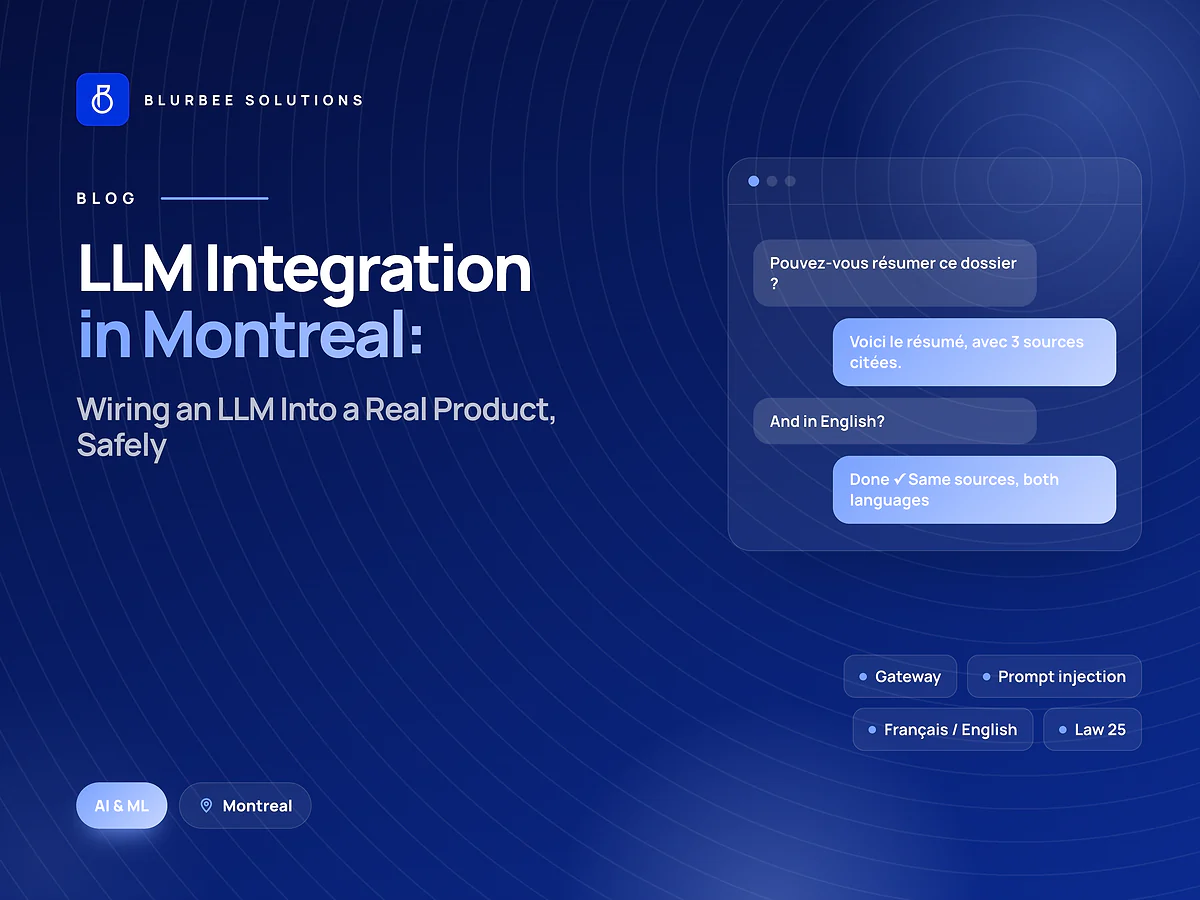
In Quebec, French is not a translation layer. The Charter of the French Language requires customer-facing software to be available in French, and users notice quickly when terminology is European French rather than Quebec French.
We decide early whether the model answers in the user's language or the interface language, and we put real examples in both languages, including mixed-language input, into the evaluation set. Quality is measured separately for each language, because a feature that works well in English can be noticeably weaker in French.
Law 25 and automated decisions
Quebec's Law 25 adds duties beyond PIPEDA: consent for specific purposes, privacy impact assessments for certain projects, and transparency when a decision about a person is made solely through automated processing, including the right to have it reviewed by a person.
Practically: log what the model was given and what it produced, keep a human path for consequential decisions, set retention limits on conversation data, and check where your model provider processes data.
Evaluation before launch
Every LLM feature ships with an evaluation set of real inputs and accepted outputs, in both languages, scored on every change to prompts, models or retrieval. It is what lets you upgrade models confidently and catch regressions before users do. For how we build these, see prompt engineering as a system.
Rates in Montreal
Montreal agencies typically charge CA$80-155 per hour for mid to senior engineering. Our blended AI team is CA$41-82. We keep 3.5 hours of live overlap with Eastern time and run the rest asynchronously with written daily handoffs.
A worked example: support reply drafting
A Montreal SaaS company wants an LLM to draft replies to support tickets in French and English. The integration looks like this:
- The ticket arrives; the gateway redacts personal identifiers the model does not need.
- Retrieval fetches relevant help articles and the customer's plan details, filtered by what the support agent is allowed to see.
- The model drafts a reply in the customer's language, citing the articles used, returned as structured output.
- The agent reviews, edits and sends. Edits are logged and feed the evaluation set.
Nothing reaches the customer without a person. Quality is tracked per language, and the gateway enforces a monthly budget. Once the evaluation scores are stable, the team can decide which ticket types, if any, are safe to send automatically.
Start with one bounded feature
The first fixed-scope project is a single feature that is useful and checkable, such as summarising records or answering questions over your documents with citations. Two to four weeks, with the gateway, guardrails and a bilingual evaluation set in place, so the second feature is faster than the first.
LLM integration in Montreal, in numbers
Blurbee delivery practice, indicative split for a first LLM feature in an existing product.
Why Montreal product teams integrate LLMs with Blurbee
Montreal teams often know the models better than most. What they want from us is production engineering: a gateway, guardrails, bilingual evaluation and costs that hold up at scale.
- Fixed-scope first projectTwo to four weeks, priced as a number rather than an estimate, so you have evidence before a longer commitment.
- One delivery lead, namedYou always know who to ask. No account manager relaying questions to a team you never meet.
- Code and IP are yoursAssigned in writing, handed over with repositories, infrastructure definitions and documentation whether or not you continue with us.
- Performance budgets in CICore Web Vitals and bundle size gate the build. Slow does not ship.
- Accessibility to WCAG 2.2 AAReviewed with automated and manual passes, not claimed on a slide.
- Written overlap disciplineStanding calls inside your working window, everything else asynchronous with a decision log.