Custom Software Development for Great Lakes Manufacturers and Retailers
Industrial and retail software across Ohio, Michigan, Illinois, Indiana, Wisconsin and Minnesota: ERP integration, inventory, shop-floor systems and where AI pays back.

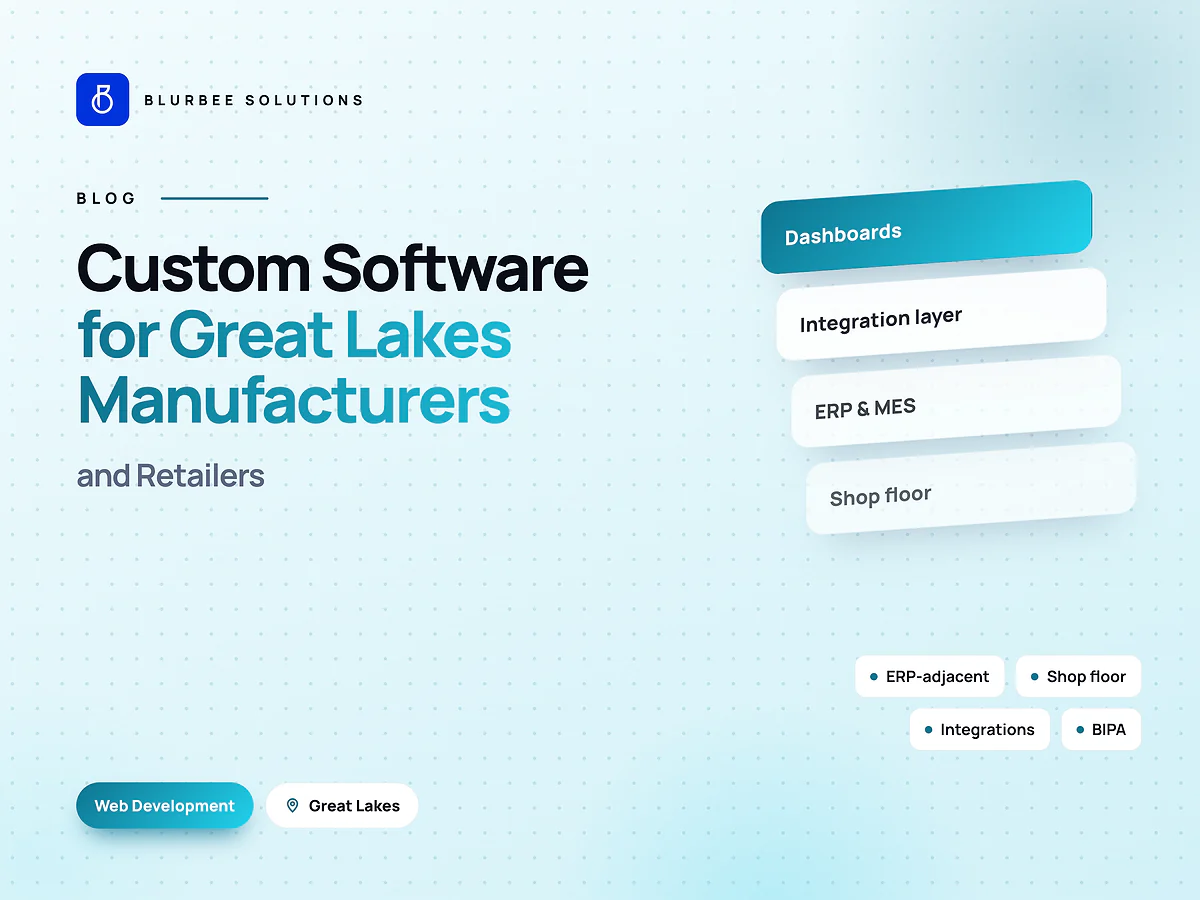
The Great Lakes states run on software that was installed a long time ago and works. That is the defining fact of industrial software here, and it makes the usual approach — propose a modern replacement — both wrong and expensive.
The right approach is almost always to integrate with what exists and build the useful layer above it.
Do not replace the ERP
ERP replacement is a multi-year programme with a well-documented failure rate, and it consumes the organisation's attention for the duration. Meanwhile, the things people actually want from a new ERP are usually not ERP functions at all:
A usable interface for the three tasks staff perform fifty times a day. Real-time visibility into orders, inventory and production status. Mobile access on the floor rather than a terminal in the office. Reports that answer the question asked rather than the question the vendor anticipated.
All four can be delivered as a layer above the existing system in six to fourteen weeks. The ERP keeps being the system of record, which is the one thing it is genuinely good at, and the interface problem gets solved separately.
We have taken this approach with SAP, Epicor, Infor, Plex, NetSuite, Sage and several systems whose vendors no longer exist. The pattern holds.
Integration, in order of preference
Sixty percent or more of a typical industrial project is integration, not interface. How you integrate determines the risk profile of the whole engagement.
A documented API. Best case. REST or SOAP, with a schema and rate limits. Rare on older systems.
A database view provided by your IT team. Very good. It gives you a stable contract, your DBA controls what is exposed, and it survives upgrades better than direct table access.
Scheduled file exchange. Perfectly adequate for most operational needs. A CSV or XML drop every fifteen minutes is real-time enough for inventory visibility, and it is robust.
Read-only database access to a replica. Workable, with the caveat that you are coupled to an internal schema that can change without notice. Document the assumption.
Screen-level integration. Last resort. Fragile, breaks on any UI change, and worth avoiding unless nothing else exists.
We start read-only on every legacy integration, without exception. The system proves it reads correctly and produces useful output before anyone discusses giving it write access. This is not caution for its own sake — an integration that writes into a production system on the basis of a misunderstood field is a very expensive category of mistake.
Where AI genuinely pays back on the floor
Four use cases work reliably, and they share a property: the data already exists and a human already makes the decision.
Defect detection from inspection images. Needs labelled examples of good, defective, and the ambiguous middle. Measured on escape rate and inspection throughput. This is the most common industrial AI win in the region.
Demand forecasting. Needs at least two years of clean history and an honest account of what changed in that period — a system migration or a pricing change mid-history produces a model that predicts the past. Measured against your current method, which is usually a spreadsheet and someone's judgement, and that is a fair baseline.
Document extraction. Purchase orders, certificates of analysis, packing lists, supplier invoices. Structured fields out of a known form type. Measured in handling time and error rate against manual entry.
Anomaly detection on machine telemetry. Needs sensor history including at least some failures. Measured on unplanned downtime. Be careful here: without failure examples, this becomes an unsupervised project with a much longer horizon.
What does not work as a first project: anything requiring data you do not yet collect, anything where the model output is the final decision with no human review, and anything where nobody can state the number that would prove it worked.
OT security is a different discipline
The operational network — PLCs, HMIs, machine controllers — should not be reachable from the business network. Any bridge between them is deliberate, documented and monitored.
Practically: a one-way gateway or data diode where possible, read-only from the OT side, and no path by which a compromised office laptop reaches a controller. This is not theoretical. Manufacturing is a heavily targeted sector, and the incidents that cause real damage usually involve exactly this bridge.
If your project needs shop-floor data in a business system, the architecture question is how to get data out safely, not how to connect the networks.
Illinois BIPA deserves a paragraph of its own
If you use fingerprint or facial recognition for time clocks or facility access, and any employee is an Illinois resident, the Biometric Information Privacy Act applies. It is the strictest such statute in the United States, it carries a private right of action, and the litigation history is substantial.
Written informed consent before collection, a published retention and destruction schedule, and no disclosure without consent. Many manufacturers in the region have concluded that badge or PIN authentication is simply not worth replacing. That is a legitimate conclusion.
Offline tolerance is an architecture decision
Software used on a floor, in a yard, or in a facility with patchy coverage has to work when the network does not. That means local storage as the source of truth, queued writes that survive an app restart, sync status the operator can actually see, and rules for what happens when two devices changed the same record.
This is decided before the data model exists. Retrofitting it is close to a rewrite. If your users are on the floor, say so in week one.
Testing something that runs a production line
Three stages, no shortcuts.
A staging environment that mirrors the integration, including realistic data volumes. Then a single line or cell running the new system in parallel with the existing process for a defined period, with both outputs compared. Then progressive rollout.
Nothing reaches a live line without a documented, tested fallback to the current process. The question "what do we do if this stops working at 2am on a Saturday" needs a written answer before go-live, and the answer cannot be "call the vendor."
Working across the time difference
Central time gives 2.5 hours of live overlap with our Surat day, 09:00-11:30 CT. That covers a standing call and real-time problem solving. Everything else runs asynchronously with a written handoff at the end of each India day.
For industrial work this suits reasonably well, because the bottleneck is rarely conversation speed — it is access to systems, plant availability for testing, and getting time with the person who knows why a field means what it means. Those are scheduled, not spontaneous.
What industrial software projects actually involve
Blurbee delivery data across industrial engagements, 2019-2026. Distribution varies with how well documented the existing systems are.
Why Great Lakes manufacturers work with Blurbee
We start by integrating with what you have rather than proposing to replace it. Most of the value in industrial software is in the layer above the ERP, and that layer can be built in weeks instead of the two-year programme a replacement would require.
- Fixed-scope first projectTwo to four weeks, priced as a number rather than an estimate, so you have evidence before a longer commitment.
- One delivery lead, namedYou always know who to ask. No account manager relaying questions to a team you never meet.
- Code and IP are yoursAssigned in writing, handed over with repositories, infrastructure definitions and documentation whether or not you continue with us.
- Performance budgets in CICore Web Vitals and bundle size gate the build. Slow does not ship.
- Accessibility to WCAG 2.2 AAReviewed with automated and manual passes, not claimed on a slide.
- Written overlap disciplineStanding calls inside your working window, everything else asynchronous with a decision log.