Computer Vision Use Cases That Pay Back in a Quarter, Not a Year
Computer vision projects that tend to pay back within a quarter, from defect detection to document capture, and how to estimate payback first.

Computer vision has a reputation for long, expensive projects that end in an impressive demo and an uncertain business case. That reputation is earned by projects that started with the technology. The ones that pay back quickly start with a number: how much a task costs today, and how much of that a camera and a model can remove.
Start with the payback maths
Before any model is trained, a computer vision idea should survive a simple calculation:
Monthly saving = volume × (cost per manual check or per missed error) × share handled automatically
Then compare that saving with the cost of the build, cameras if needed, and running costs. If payback is not clear on paper, it will not appear in production.
The use cases below tend to pay back fastest because all three inputs are favourable: high volume, a clear cost per item, and a task narrow enough to automate reliably.
1. Document and ID capture
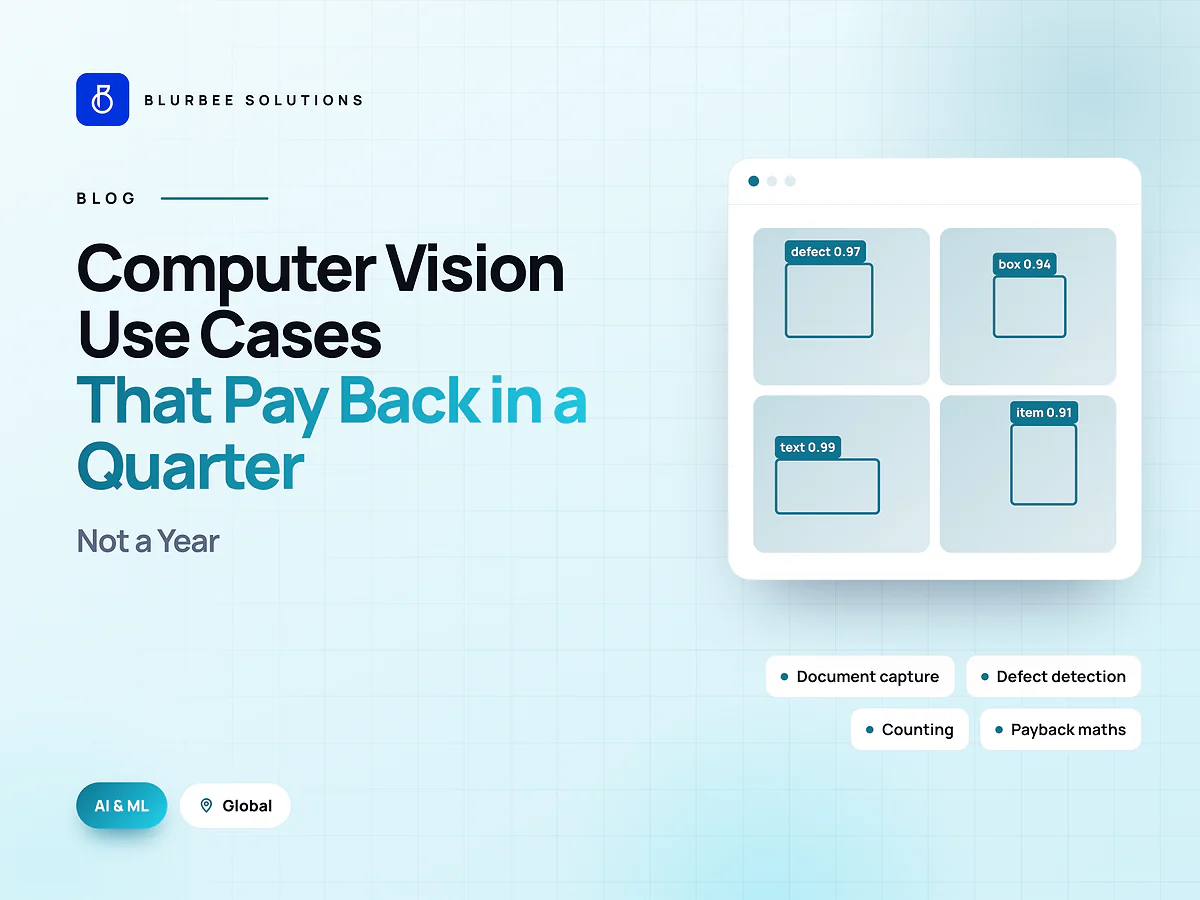
Reading invoices, delivery notes, forms, identity documents and receipts, and entering the data into a system. The volume is high, the manual cost per document is easy to measure, and modern models combined with OCR handle most documents well. Uncertain fields go to a person for review.
This is often the fastest payback of all, because it replaces repetitive data entry directly.
2. Visual defect detection
Checking products on a line for scratches, cracks, misprints, missing parts or wrong labels. A missed defect has a clear cost in returns, rework or recalls, and manual inspection is tiring and inconsistent over a shift.
The conditions matter: consistent lighting and camera position make a large difference. Fast or fine-detail inspection may need industrial cameras and controlled lighting; many slower lines work with simpler setups.
3. Counting and measurement
Counting items on pallets, in bins or passing a point; measuring dimensions; estimating fill levels. These tasks are well defined and easy to verify, and they replace manual counts that are slow and error-prone.
4. Safety and PPE checks
Detecting whether hard hats, vests or gloves are worn in specific zones, or whether people enter restricted areas near machinery. The payback is real but harder to quantify, because it comes from incidents avoided. Privacy needs care: focus on equipment and zones, not on identifying individuals.
5. Retail shelf monitoring
Detecting empty shelves, misplaced products and pricing label issues. It pays back where lost sales from out-of-stock items are significant and store audits are costly. Camera placement and store variety make it harder than factory use cases.
What pays back slowly
General scene understanding, such as "tell us everything happening in the warehouse", is hard to measure and hard to make reliable. Tasks with very rare events need large amounts of data to learn. Projects without a clear owner of the process being improved rarely reach production.
Why pilots fail, and how to avoid it
- Training images do not match reality. We collect data from the actual cameras, lighting and angles.
- Rare cases are missing. We deliberately collect and label edge cases, and track performance on them separately.
- The accuracy target is unrealistic. We set a confidence threshold: confident predictions are acted on, uncertain ones go to a person.
- No plan for errors. We define in advance what happens when the model is wrong.
Edge or cloud
Models can run on edge devices next to the camera, which cuts latency and bandwidth and keeps images on-site. That suits factories, warehouses and remote locations. Cloud processing is simpler to manage when connectivity is good and latency is not critical.
Privacy
When cameras capture people, collect only what the task needs, blur faces where identity is irrelevant, limit retention and inform people. GDPR, UK GDPR, India's DPDP Act, US state laws such as CCPA and the UAE PDPL all apply depending on where you operate.
Keep it in production
After launch, lighting changes, products change and cameras get moved. Monitor accuracy on a sample of reviewed predictions and retrain when it slips; see MLOps from notebook to production.
A worked payback example
Take document capture as an illustration. Suppose a team processes 20,000 delivery notes a month, and manual entry and checking takes three minutes each. That is 1,000 hours of work a month.
If a model reads the documents and 80% are confident enough to go straight into the system, with the remaining 20% reviewed by a person, and review takes one minute each, manual time falls to roughly 70 hours a month for review plus exception handling. The saving is several hundred hours a month.
Multiply by your fully loaded hourly cost and compare with the build and running costs. For many teams, that payback lands within a quarter. If your volume is a tenth of this, payback is ten times slower, which is exactly why the calculation comes first.
These numbers are illustrative. Use your own volumes, times and costs.
Questions to answer before a pilot
- What is the monthly volume, and is it stable?
- What does each manual check or missed error cost today?
- Who owns the process, and will they change it if the pilot works?
- Can we collect a few hundred real images from the actual cameras or scanners?
- What happens when the model is uncertain?
Start with a feasibility test
Our first fixed-scope project is two to four weeks: we estimate payback with your numbers, test feasibility on a few hundred of your images, and report measured accuracy and a revised payback figure. Then you decide whether a pilot is worth it.
We deliver computer vision for teams across India, the United States, the United Kingdom, the UAE and Canada; see AI and ML services.
Computer vision payback, in numbers
Blurbee's assessment of typical payback speed, scored out of 10 where 10 is fastest. Opinion based on our engagements; your volumes decide the real answer.
Why operations teams pilot computer vision with Blurbee
We estimate payback before we train anything, test on your own images and conditions, and keep a person in the loop on uncertain cases. Pilots are sized to prove the number, not to impress in a demo.
- Fixed-scope first projectTwo to four weeks, priced as a number rather than an estimate, so you have evidence before a longer commitment.
- One delivery lead, namedYou always know who to ask. No account manager relaying questions to a team you never meet.
- Code and IP are yoursAssigned in writing, handed over with repositories, infrastructure definitions and documentation whether or not you continue with us.
- Performance budgets in CICore Web Vitals and bundle size gate the build. Slow does not ship.
- Accessibility to WCAG 2.2 AAReviewed with automated and manual passes, not claimed on a slide.
- Written overlap disciplineStanding calls inside your working window, everything else asynchronous with a decision log.