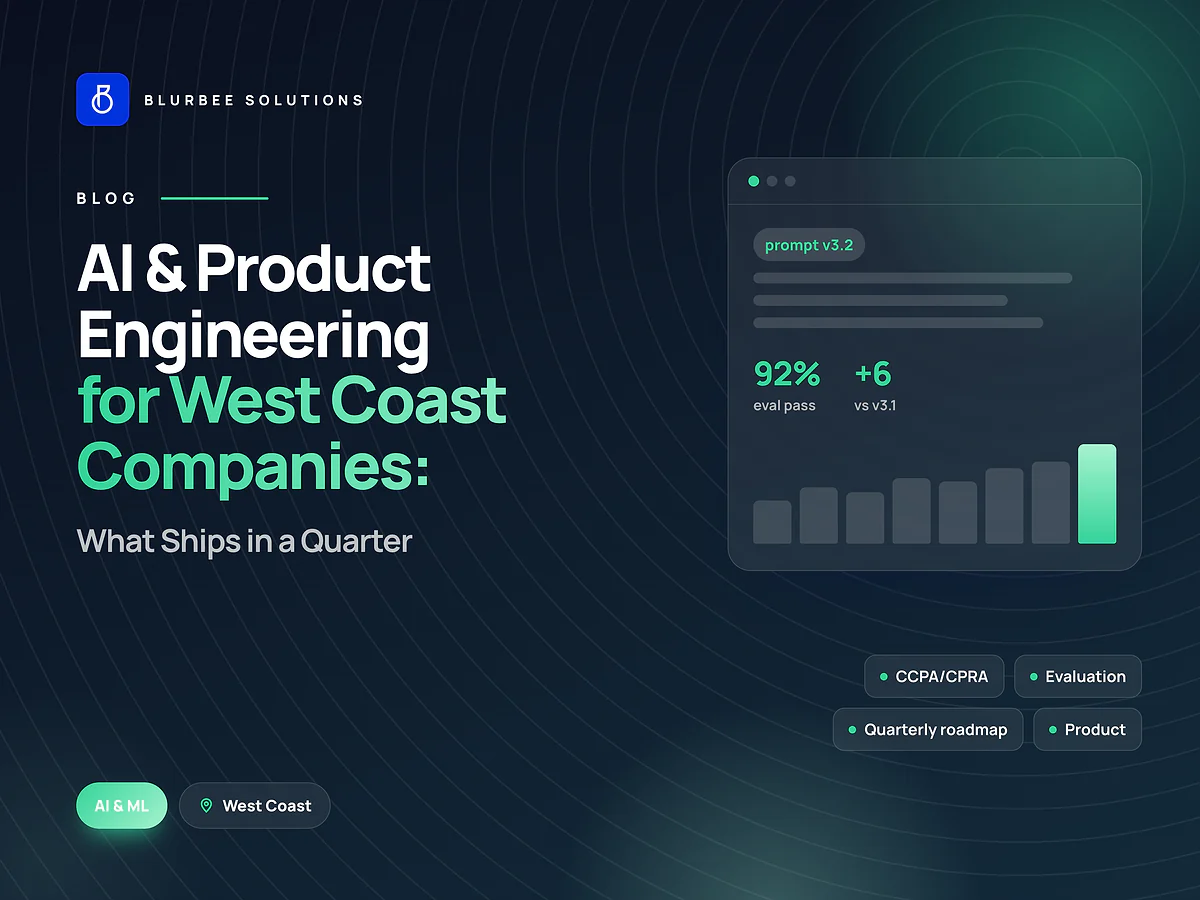
AI and Product Engineering for West Coast Companies: What Ships in a Quarter
A realistic 90-day plan for California, Oregon and Washington companies shipping AI features: data readiness, evaluation harness, integration, rollout and cost control.

West Coast teams do not usually need convincing that AI is worth building. They need a plan that survives a security review, a cost model that does not break at scale, and someone willing to say which of the six ideas on the roadmap can actually ship this quarter.
This is that plan.
The three-part filter
A first AI feature should satisfy three conditions. Fail any one and it is not impossible, just not first.
The data already exists, in a system you can access, with enough history to evaluate against.
The output feeds a decision a human already makes. You are making an existing judgement faster or more consistent, not creating a new autonomous one.
Someone can name the number that proves it worked, and that number was already being measured before the project started.
The reason to be strict is that a first AI feature buys organisational permission as much as capability. One that ships and demonstrably works funds the next three. One that becomes a research programme ends the conversation.
What ships in ninety days
Retrieval-augmented search over your own corpus. Natural-language questions answered from your documents, with citations. Needs a corpus that is current and a clear model of who may see what. Measured in time-to-answer and reduction in questions escalated to experts. The failure mode is a stale index, so the ingestion pipeline matters more than the model choice.
Document extraction. Structured fields out of a known document type into your existing systems. Needs a few hundred labelled examples and a defined schema. Measured in handling time and error rate against manual entry. The most reliable first project available.
Classification and routing. Tickets, emails, or inbound leads categorised and routed. Needs twelve months of history with eventual resolution attached. Measured in first-touch accuracy. Unglamorous and consistently high return.
A grounded assistant with escalation. Answers only from your documentation, sources shown, clean handoff to a human. Needs documentation that is actually correct, which is frequently the real project.
Summarisation with review. Call notes, long threads, research digests, with a human approving before anything is acted on. Low risk because the review step is built in.
Forecasting. Where two years of clean history exists and you can account for what changed in that period.
Build the evaluation harness first
This is the practice that separates features that ship from pilots that stall, and it is 20% of the effort.
Before any model work: a held-out set of real examples with known correct answers, and a script that scores any candidate approach automatically. For extraction, a few hundred documents with correct field values. For retrieval, real questions paired with the passage that should have been returned. For classification, held-out records with true labels.
Every change then becomes measurable. Model swaps, prompt changes, chunking strategies — all comparable on the same numbers.
A useful side effect: assembling the harness usually reveals the task is either easier or harder than assumed, early enough to change the plan rather than the deadline.
Where the effort actually goes
Across our engagements: 35% data access and cleaning, 25% integration and interface, 20% evaluation harness, 12% model work, 8% monitoring and cost control.
That distribution predicts where delays come from. The two-week slip is almost never the model. It is a data access request sitting with a security team, or the discovery that a field everyone described as a category is a free-text box with four thousand distinct values.
Scope accordingly, and get the access requests in during week one.
Cost control from week one
The characteristic failure of a successful AI feature is a bill that scales with adoption faster than the value does. Instrument cost per request before launch, not after the invoice.
The levers, in order of usual effectiveness: caching identical and near-identical requests; routing easy cases to a smaller model and escalating only hard ones; trimming context aggressively, because most prompts carry material the model does not need; and batching where latency tolerance allows.
Expect to spend real engineering time on this in month three. Budget for it rather than treating it as a surprise.
Design for being wrong
Grounding in retrieved sources with citations the user can check. Explicit refusal when confidence is low, which is better product behaviour than a confident guess. Human review for anything consequential. And logging of every low-confidence response, which becomes the evaluation data for the next iteration.
The framing that helps: you are not building a system that is right. You are building a system whose wrongness is visible, bounded and recoverable.
Compliance, specifically
California CCPA/CPRA. Deletion is the architectural problem. If personal data has been embedded into a vector store, honouring a deletion request means finding and removing those embeddings — which requires designing the index with document-level provenance from the start. Also: service-provider contract terms with any model vendor, and opt-out signal handling.
Washington My Health My Data. The definition of consumer health data is broad enough to catch wellness, fitness and symptom features. It requires separate consent for collection and for sharing, and it carries a private right of action. Worth a specific legal read early.
Oregon. OCPA applies, with the usual access, correction and deletion rights.
Across all three: if your data cannot leave your control, that constrains the model choice before anything else does. Establish it first.
Fitting an existing platform
Most West Coast teams we work with already have platform standards, a design system, an opinion about tooling and a security review process. Fitting all of that is nearly always cheaper and better for your team than proposing alternatives, and it is usually the entire value of bringing in outside capacity.
Where we think something has a genuine problem, we say so with evidence and leave the decision with you. What we do not do is arrive with a preferred stack and reshape the project around it.
The one-hour overlap
Pacific gives roughly 08:30-09:30 PT of live overlap with our Surat day, plus an early-morning IST slot that covers Pacific late afternoon when something is urgent.
AI work suits this better than most. The bottlenecks are data access approvals and evaluation results, both asynchronous by nature. A standing call inside the window, a written handoff at the end of each India day, and a decision log covers it.
The 90-day shape of an AI feature
Blurbee delivery data across AI/ML engagements, 2019-2026.
Why West Coast product teams work with Blurbee
We build the evaluation harness before the model, instrument cost per request from week one, and fit your existing platform rather than proposing a better one. For teams that already have standards, that is the whole job.
- Fixed-scope first projectTwo to four weeks, priced as a number rather than an estimate, so you have evidence before a longer commitment.
- One delivery lead, namedYou always know who to ask. No account manager relaying questions to a team you never meet.
- Code and IP are yoursAssigned in writing, handed over with repositories, infrastructure definitions and documentation whether or not you continue with us.
- Performance budgets in CICore Web Vitals and bundle size gate the build. Slow does not ship.
- Accessibility to WCAG 2.2 AAReviewed with automated and manual passes, not claimed on a slide.
- Written overlap disciplineStanding calls inside your working window, everything else asynchronous with a decision log.