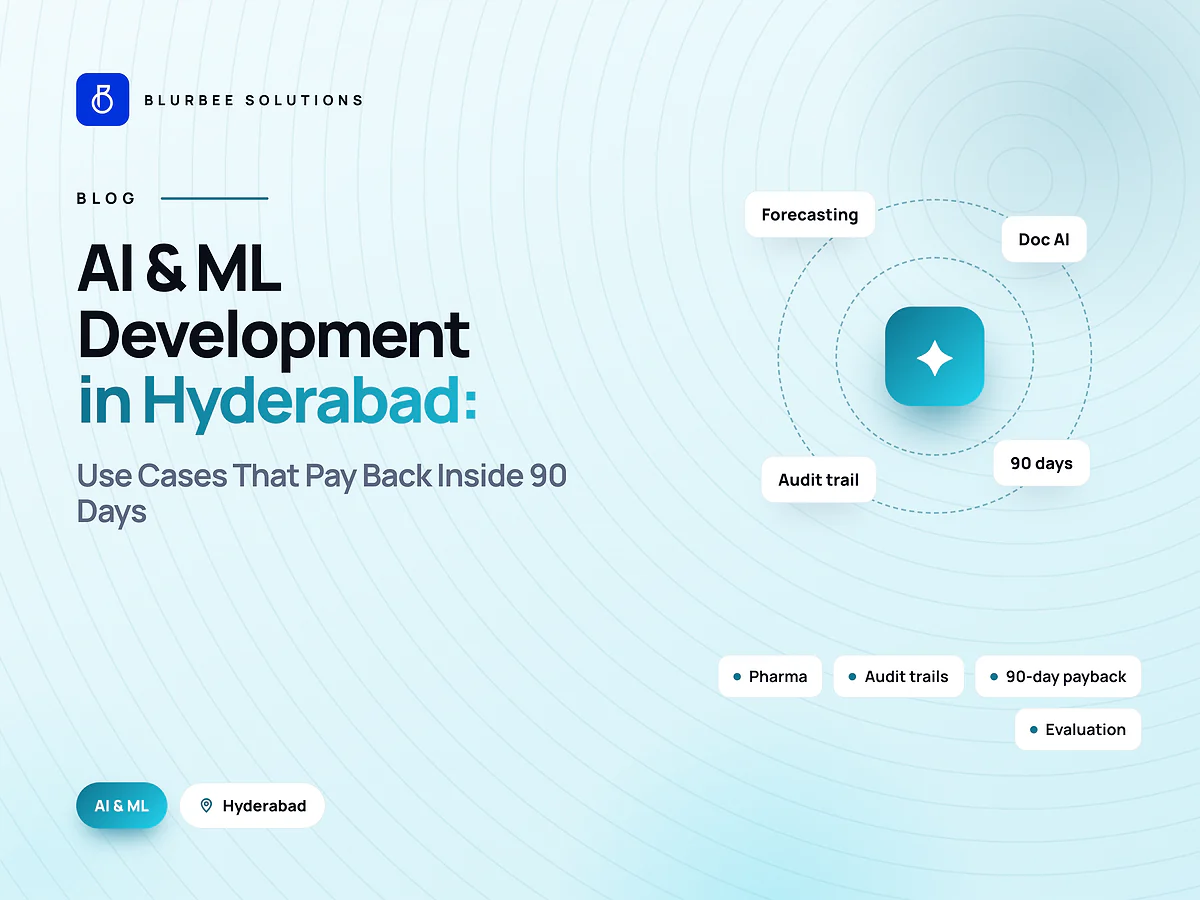
AI and ML Development in Hyderabad: Use Cases That Pay Back Inside 90 Days
Six AI and ML use cases Hyderabad businesses can deploy in a quarter, with the data each one needs, the integration work involved, and how to measure return.

Most AI projects fail in the same place: not the model, but the point where a working prototype meets a real system and nobody has decided who is accountable for a wrong answer. Hyderabad businesses have a specific advantage here — the pharma and enterprise IT clusters have decades of experience with validated, auditable systems — and a specific disadvantage, which is that those same standards make sloppy AI deployment impossible.
This is a practical list of what can reach production in a quarter, what each one needs, and how to tell whether it worked.
The 90-day test
Before any use case, one filter. A first AI feature should satisfy three conditions:
- The data already exists, in a system you can access, with enough history to evaluate against.
- The output feeds a decision a human already makes. You are making an existing judgement faster or more consistently, not creating a new autonomous one.
- Someone can state the number that proves it worked, and that number was already being measured before the project started.
Fail any of these and the project is not impossible, it is just not a first project. The reason to be strict is that a first AI feature is buying organisational permission as much as capability. One that ships and demonstrably works funds the next three. One that becomes a nine-month research programme ends the conversation.
Six use cases that fit
Document extraction. Invoices, purchase orders, lab reports, forms of a known type. Input is a scanned or PDF document, output is structured fields into your existing system. Needs a few hundred labelled examples and a defined schema. Return is measured in handling time per document and error rate versus manual entry. This is the most reliable first project in the list.
Retrieval-augmented search. Your own documents made answerable in natural language, with citations. Needs a corpus that is reasonably current and a definition of who is allowed to see what. Return is measured in time-to-answer and reduction in internal questions escalated to experts. The failure mode is a stale corpus, so the ingestion pipeline matters more than the model.
Ticket and email classification. Incoming messages routed by category, urgency and required team. Needs twelve months of historical tickets with their eventual resolution. Return is measured in first-touch accuracy and time to correct queue. Straightforward, unglamorous, and consistently the highest-ROI item on this list for services businesses.
Forecasting. Demand, churn, collections risk. Needs at least two years of clean history and an honest account of what changed in that period — a system migration or a pricing change mid-history will produce a model that predicts the past. Return is measured against the current forecasting method, which is usually a spreadsheet and someone's judgement, and that is a fair baseline to beat.
A grounded support assistant. Answers drawn only from your documentation, with sources shown and an escalation path to a human. Needs documentation that is actually correct, which is often the real project. Return is measured in resolution without human touch, and it should be measured conservatively.
Quality-control image classification. Defect detection on a production line or in inspection photos. Needs labelled examples of both good and defective, including the ambiguous cases. Return is measured in escape rate and inspection throughput. Hyderabad's manufacturing and pharma base makes this more common here than in most Indian cities.
Where the effort actually goes
The model is rarely the expensive part. Across our engagements the split is roughly: 35% getting access to data and cleaning it, 20% building the evaluation harness, 25% integration and interface, 12% model work, and 8% monitoring and cost control.
That distribution is worth internalising before you scope a project, because it predicts where delays come from. The two-week slip on an AI project is almost never the model; it is a data access request sitting with a security team, or a discovery that the field everyone assumed was a category is a free-text box with 4,000 distinct values.
The evaluation harness comes first
This is the single practice that separates AI features that ship from pilots that stall.
Before any model work, we build a held-out set of real examples with known correct answers, and a script that scores any candidate approach against it automatically. Every change is then measurable. Without it, the only available judgement is "it seems better," which cannot survive a review meeting and should not.
For a document extraction task that means a few hundred documents with their correct field values. For retrieval, a set of real questions with the passage that should have been retrieved. For classification, held-out tickets with their true category. It is tedious to assemble and it is the thing that makes the rest of the project honest.
A useful side effect: building the harness usually reveals that the task is either easier or harder than assumed, early enough to change the plan.
Compliance in the Hyderabad context
The pharma cluster around Genome Valley generates a class of requirement most software teams have never encountered. Validated systems, audit trails in the style of 21 CFR Part 11, formal change control, and documented evidence of model behaviour at release. If your AI feature touches a regulated process, that work is not optional and it is not fast — expect it to add weeks and to require documentation written for an auditor rather than a developer.
Separately, the Digital Personal Data Protection Act, 2023 governs the personal data flowing into any model: consent for the purpose, purpose limitation, and the ability to honour deletion requests, which is a genuine architectural constraint if personal data has been embedded into a vector store.
Scope this explicitly at the start. Discovering it in review is the most expensive way to learn it.
What to budget
A data-readiness audit is ₹1.5–4 lakh over one to two weeks and is the right first purchase for most organisations. A first production feature is typically ₹8–30 lakh over eight to sixteen weeks. Running costs are separate and volume-dependent; a retrieval system over a few hundred thousand documents commonly costs ₹15,000–1.5 lakh per month in inference and storage.
Instrument cost per request from the first week. The characteristic failure of a successful AI feature is a bill that grows with adoption faster than the value does, and it is much easier to design for that than to retrofit it.
How to know it worked
Pick the number before you start. Handling time per document. Percentage of tickets routed correctly on first touch. Forecast error against the current method. Resolution rate without human involvement. Then measure it for two weeks before launch so you have a baseline that is not a memory.
If nobody can name that number, the honest recommendation is to postpone the project and spend two weeks instrumenting the process instead. It is cheaper, and it is the only way the AI work will ever be defensible.
AI adoption context, in numbers
Blurbee delivery data across AI/ML engagements, 2019–2026. The model is rarely the expensive part.
Why Hyderabad teams bring us AI work
We scope AI against your data before anyone writes a model, and we build the evaluation harness first. That is unglamorous and it is the difference between a feature that ships and a pilot that dies in review.
- Fixed-scope first projectTwo to four weeks, priced as a number rather than an estimate, so you have evidence before a longer commitment.
- One delivery lead, namedYou always know who to ask. No account manager relaying questions to a team you never meet.
- Code and IP are yoursAssigned in writing, handed over with repositories, infrastructure definitions and documentation whether or not you continue with us.
- Performance budgets in CICore Web Vitals and bundle size gate the build. Slow does not ship.
- Accessibility to WCAG 2.2 AAReviewed with automated and manual passes, not claimed on a slide.
- Written overlap disciplineStanding calls inside your working window, everything else asynchronous with a decision log.