AI Chatbots and Assistants in London: Chatbots That Actually Resolve Tickets, Not Just Deflect Them
Resolution, not deflection: how London teams should scope an AI assistant, meet UK GDPR and FCA Consumer Duty, and budget realistically in GBP.

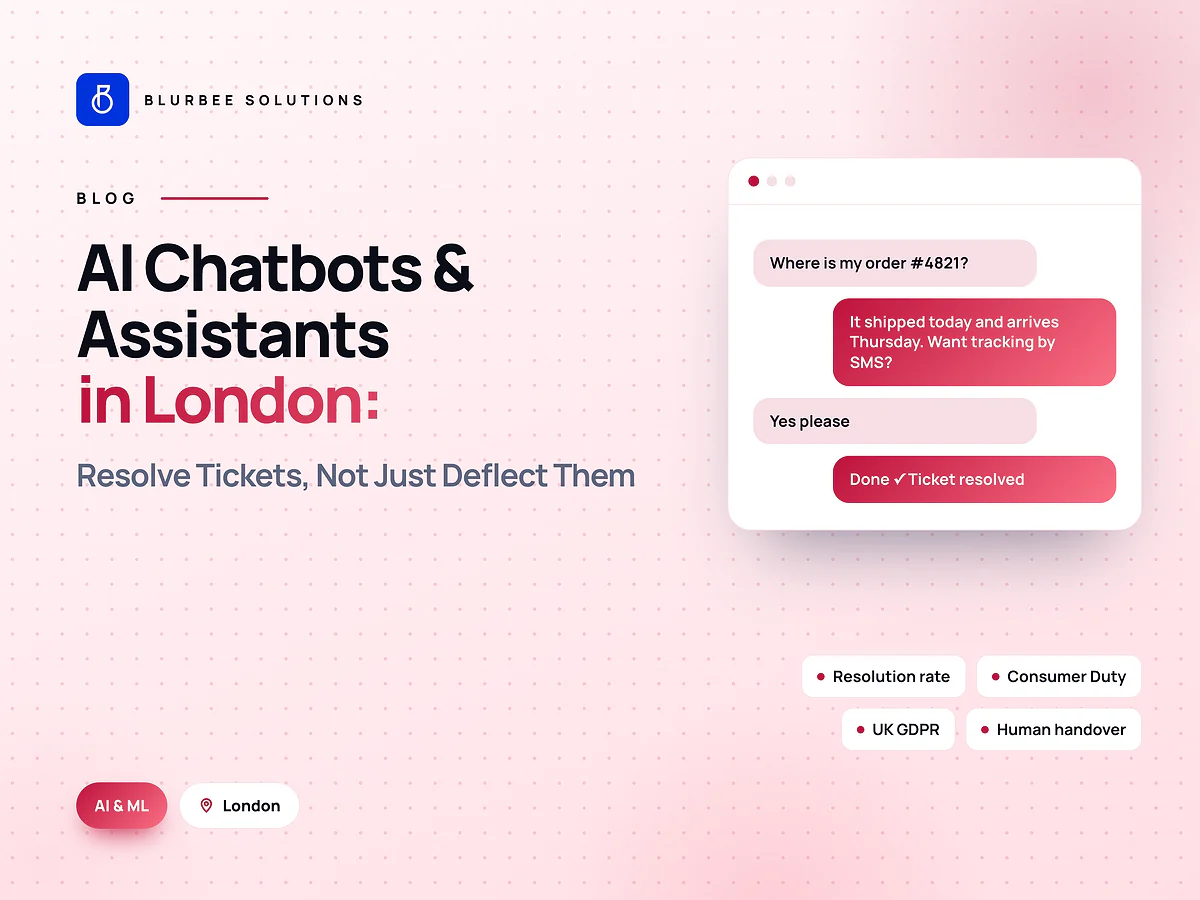
Most customer-service chatbots are measured on the wrong number. "Deflection rate" counts every conversation that didn't reach a human, which rewards a bot for being hard to escape. For a London fintech under FCA Consumer Duty, that metric is worse than useless. A customer who gives up is not a customer whose problem was solved.
The number worth building for is resolution: the problem fixed, confirmed by the customer not coming back about it.
Deflection versus resolution
The difference shows up in the data within weeks. A bot optimised for deflection gets a high headline figure and a quiet rise in repeat contacts, complaints and churn. One optimised for resolution shows a lower initial "automation rate" and a real drop in total ticket volume.
We define resolution per intent: a conversation counts as resolved if the customer did not contact you again on the same issue within a set window, usually seven days. It is harder to measure, and that is the point.
Choose intents an assistant can complete
Start with what the tickets say, not what the product team imagines. A month of anonymised tickets, clustered by intent, shows where volume actually sits. Good first candidates share three features: high volume, low risk and a clear right answer that can be completed end to end.
Typical first set for a London fintech or subscription business: payment and order status, address and contact changes, statement or invoice requests, card or account lock questions, and plain policy questions. Complaints, anything that looks like financial advice, and conversations showing signs of vulnerability should go to a person until the basics are proven.
Resolution needs actions, not answers
A chatbot that explains how to change your address is still sending you to do it yourself. An assistant that changes it, with confirmation, resolves the ticket.
That means integration with your systems through their APIs, and each action needs:
- Permission rules, meaning what the assistant can do, for whom, and with what verification.
- Explicit confirmation from the customer before anything changes.
- An audit log recording what was done, when, and on what instruction.
- Human approval for anything irreversible or above a value threshold.
This is most of the engineering. The language model is the easy part.
Design the escalation path first
The handover to a human decides whether customers trust the assistant. Done well, the agent receives the full transcript, the detected intent, anything already collected, and the reason for escalation, and the customer never repeats themselves.
Escalation should always be one step away. Some triggers should escalate automatically: repeated misunderstanding, expressions of distress or financial difficulty, and any request to speak to a person.
FCA Consumer Duty
The Consumer Duty, in force since 31 July 2023, requires regulated firms to deliver and evidence good outcomes for retail customers, and customer support is squarely inside it. An assistant that obstructs access to a human, gives unclear answers, or handles vulnerable customers badly is a conduct problem, not just a product one.
Practically, that means keeping outcome evidence (resolution rates, escalation reasons and complaint patterns by intent), testing specifically with vulnerable-customer scenarios, and reviewing transcripts regularly with someone from compliance.
UK GDPR and the data you collect
Conversation transcripts are personal data, often sensitive. The essentials:
- Transparency that the customer is talking to an AI system.
- A lawful basis for processing and a retention limit on transcripts, enforced in the system.
- Data minimisation: redact identifiers the model does not need before it sees them.
- Processor agreements with every model provider involved, and a record of where they process data.
- Article 22: if the assistant makes decisions with legal or similarly significant effects, such as declining something, solely automated decision-making is restricted.
If you also serve EU customers, the EU AI Act adds transparency duties for systems that interact with people. Designing disclosure and logging in from the start covers both.
Evaluation before and after launch
Before launch, an evaluation set of real anonymised conversations with accepted outcomes, scored on every change. After launch, a weekly review of resolution by intent, escalation reasons, post-conversation satisfaction and a sample of transcripts read by a person. Every failure becomes a new test case.
A first release, week by week
Weeks 1-2: analysis. Cluster a month of anonymised tickets by intent, measure volume and handling time for each, and choose the first three to five intents together with your support lead.
Weeks 3-5: build. Conversation flows, integrations for the actions, escalation into your helpdesk, redaction and logging, and an evaluation set built from real conversations.
Weeks 6-7: controlled launch. Release to a small share of traffic, read transcripts daily, fix failures and add them to the evaluation set.
Weeks 8-10: scale and report. Widen the rollout, publish weekly resolution by intent, and agree the next intents based on the data.
Rates in London
London AI consultancies typically charge £100-130 per hour. Agencies run £70-110, and specialist contractors roughly £60-100 when day rates are converted. Our blended team, including QA and a delivery lead, is £24-47.
A first release covering a handful of high-volume intents, with actions, escalation and evaluation in place, usually takes six to ten weeks.
Five hours of overlap
London is our easiest Western market to work with. A 10:00-20:00 IST day overlaps five hours with London business hours, so the engineers tuning your assistant are online while your support team is reviewing its conversations.
Start with the tickets
The first fixed-scope project is analysis plus one intent: cluster a month of tickets, pick the best candidate, and build it end to end with escalation and evaluation. Two to four weeks, and you finish with a real resolution number rather than a demo.
AI assistants in London, in numbers
Composite of published London consultancy and agency rate cards, contractor day rates divided by 7.5 hours, and Blurbee quoted rates converted at prevailing rates, 2026.
Why London teams build AI assistants with Blurbee
We measure assistants on verified resolution, not deflection, and design the escalation path before the conversation flows. With five hours of overlap with London, the people tuning your assistant are online while your support team is.
- Fixed-scope first projectTwo to four weeks, priced as a number rather than an estimate, so you have evidence before a longer commitment.
- One delivery lead, namedYou always know who to ask. No account manager relaying questions to a team you never meet.
- Code and IP are yoursAssigned in writing, handed over with repositories, infrastructure definitions and documentation whether or not you continue with us.
- Performance budgets in CICore Web Vitals and bundle size gate the build. Slow does not ship.
- Accessibility to WCAG 2.2 AAReviewed with automated and manual passes, not claimed on a slide.
- Written overlap disciplineStanding calls inside your working window, everything else asynchronous with a decision log.