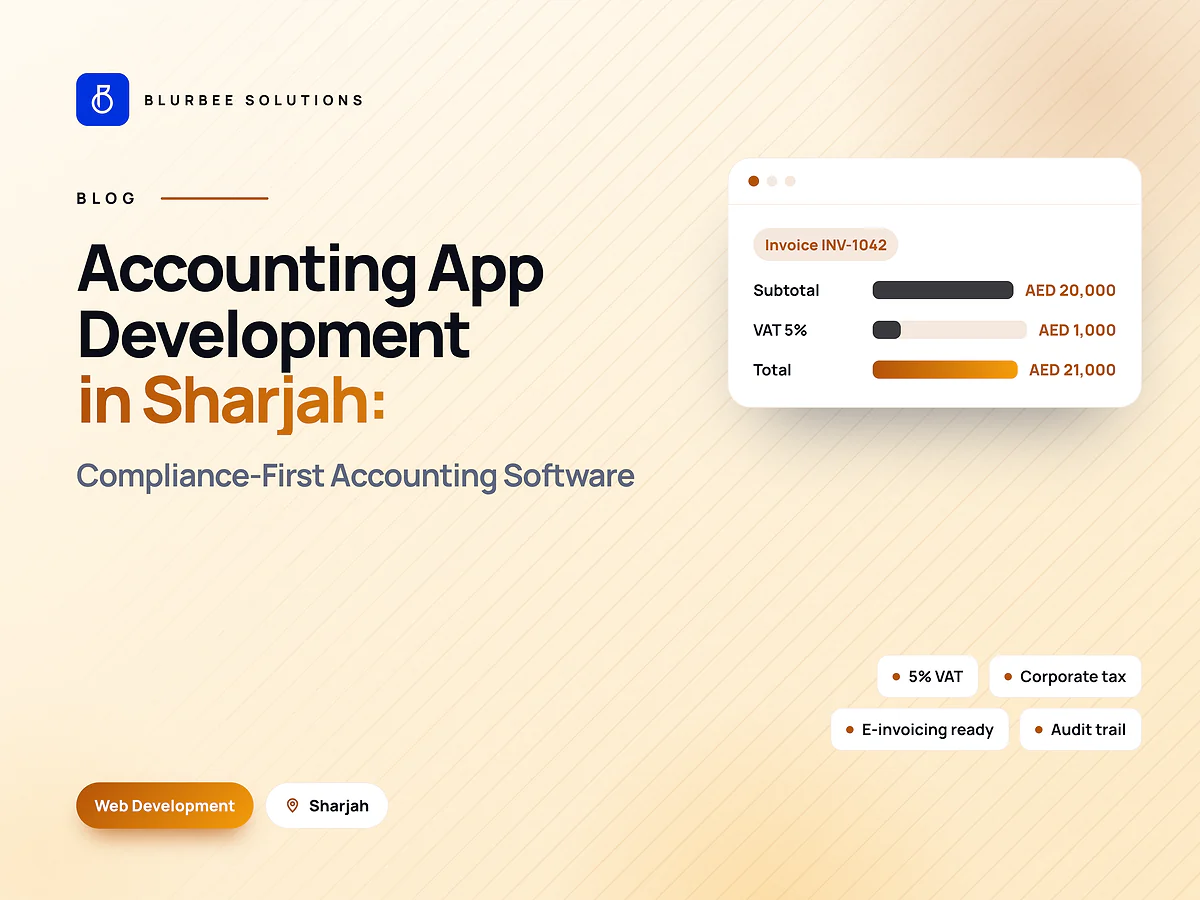
Accounting App Development in Sharjah: Compliance-First Accounting Software, Built Right
Building accounting software for Sharjah SMEs: UAE VAT and corporate tax, e-invoicing readiness, audit trails, multi-currency trading, Arabic and AED budgets.

Most Sharjah SMEs start their finance stack the same way: an off-the-shelf package, a lot of spreadsheets around it, and an accountant who reconciles the two at month end. That works until the business grows into something the package was not built for: multi-currency trading, landed costs on imports, manufacturing costing, or an ordering system that needs to post to the ledger automatically.
At that point the question becomes whether to build. This guide covers when building makes sense for a Sharjah business, and what accounting software must get right in the UAE.
Buy first, build when the business model demands it
For standard bookkeeping, a reputable package that supports UAE VAT is the right answer. It is cheaper, maintained by someone else, and familiar to accountants.
Custom software, or a custom layer on top of a package, earns its cost when:
- Your trading model is unusual, such as multi-currency purchasing with landed-cost allocation across freight, duty and insurance.
- Operations and finance are disconnected, with orders, inventory and invoices re-keyed between systems.
- Manufacturing costing needs bills of materials and work-in-progress valuation that packages handle poorly.
- Group structures span mainland and free-zone entities with intercompany transactions.
Often the best answer is to keep the package as the ledger and build the integration and operational layer around it.
Compliance starts at the ledger
Accounting software for the UAE must be designed around tax rules from the first table, not patched later.
VAT. The standard rate has been 5% since 1 January 2018. The system must apply the right treatment per line, including standard-rated, zero-rated and exempt supplies, and reverse charge on imports, then produce compliant tax invoices, credit notes and VAT return figures.
Corporate tax. Since financial years starting on or after 1 June 2023, corporate tax applies at 9% on taxable income above AED 375,000, with specific rules for qualifying free-zone persons. The software should produce clean accounts and tag transactions so your adviser can apply the right treatment.
Record retention. The FTA requires VAT records to be kept for at least five years. That shapes storage, archiving and how deleted or corrected records are handled.
E-invoicing readiness
The Ministry of Finance has announced a phased e-invoicing rollout using the Peppol model, starting with a pilot and moving to mandatory phases by business size. Rather than guess the final details, we design for readiness:
- Structured invoice data, not just PDFs.
- Unique, sequential invoice identifiers and immutable issued invoices.
- A clean integration point for an accredited e-invoicing service provider.
Check the current FTA timetable before committing to a go-live date.
Audit trails are non-negotiable
Posted transactions should never be edited in place. Corrections are new entries, and every create, change, approval and reversal is logged with who, when and why. This is what turns an FTA query or an external audit into a report rather than a reconstruction exercise.
Multi-currency and landed costs
Sharjah traders commonly buy in USD, EUR or CNY and sell in AED. The system needs transaction-date exchange rates, realised and unrealised gains and losses, and AED reporting. For importers, landed-cost allocation across freight, customs duty and insurance decides whether margins are real.
Arabic and English
Tax invoices can generally be issued in English, but the FTA can request Arabic translations and many customers expect bilingual documents. We design invoice templates, customer names and addresses for both scripts from the start, with right-to-left layouts where Arabic leads.
SME-sized engagements
Sharjah businesses, including those in Sharjah Media City (Shams), are usually cost-conscious, so we scope in modules. A typical sequence: invoicing and receivables with VAT first, then purchasing and payables, then inventory and landed costs, then reporting. Each module is useful on its own.
Sharjah agencies typically charge AED 130-290 per hour. Our blended team is AED 81-165. A first module usually takes six to ten weeks. IST is only 1.5 hours ahead of Gulf Standard Time, so we share a full working day with your finance team.
Red flags in accounting software proposals
- Posted entries can be edited rather than reversed.
- VAT is a single percentage field with no handling for zero-rated, exempt or reverse-charge lines.
- No mention of record retention or how archived data stays accessible for audit.
- Exchange rates entered by hand with no gain and loss calculation.
- Invoices only as PDFs, with no structured data for e-invoicing.
- The vendor keeps the code and hosting in its own accounts.
Any one of these will cost you later, usually during an audit or a tax review.
Start with invoicing and VAT
The first fixed-scope project is invoicing and receivables with correct VAT handling, an audit trail and bilingual invoices. Two to four weeks for the first slice, built so the next modules plug in cleanly. For related reading, see custom CRM vs off-the-shelf in Abu Dhabi and what a maintenance retainer should cover.
This article is general information, not tax advice. Confirm treatments with a UAE-registered tax adviser.
Accounting software in the UAE, in numbers
Composite of published UAE agency rate cards and Blurbee quoted rates converted at prevailing rates, 2026. Indicative bands only.
Why Sharjah SMEs build finance software with Blurbee
We build compliance in from the ledger up: tax rules, audit trails and record retention are designed first, so the software survives an FTA review. And we share your whole working day.
- Fixed-scope first projectTwo to four weeks, priced as a number rather than an estimate, so you have evidence before a longer commitment.
- One delivery lead, namedYou always know who to ask. No account manager relaying questions to a team you never meet.
- Code and IP are yoursAssigned in writing, handed over with repositories, infrastructure definitions and documentation whether or not you continue with us.
- Performance budgets in CICore Web Vitals and bundle size gate the build. Slow does not ship.
- Accessibility to WCAG 2.2 AAReviewed with automated and manual passes, not claimed on a slide.
- Written overlap disciplineStanding calls inside your working window, everything else asynchronous with a decision log.