How to Hire AI Developers in 2026: The Roles, Skills, Rates and Hiring Models That Work
Which AI roles you actually need, how to tell real AI engineering skill from demo-building, what AI developers cost in the US and offshore, and how to hire well.

Almost every product roadmap now has an AI item on it, and almost every hiring manager has discovered how hard it is to staff. AI talent is scarce, expensive and hard to assess, partly because the skills that make a convincing demo are not the skills that make a reliable production system.
This guide explains which AI roles you really need, how to test for the right skills, what AI developers cost, and which hiring model fits your situation.
Why demand keeps rising
Adoption is moving from experiments to production. McKinsey's 2026 State of AI research found that 40% of respondents from large organizations report scaling AI agents, up from 27% the year before (McKinsey). Scaling needs engineers who can build, integrate, evaluate and operate AI systems, not only prototype them.
The broader market is tight too. The US Bureau of Labor Statistics reports a median annual wage of $133,080 for software developers in May 2024, with employment projected to grow 15% from 2024 to 2034 (BLS). Engineers with proven AI experience typically command more.
Which AI roles do you actually need?
"AI developer" covers several different jobs. Most companies need fewer research scientists and more engineers than they think.
AI engineer (applied LLM engineer)
Builds products on top of existing foundation models: retrieval-augmented generation (RAG), agents, tool use, prompt design, evaluation and integration with your systems. This is the role most businesses need first.
Machine learning engineer
Trains, tunes and deploys models on your own data, such as classification, forecasting, recommendations and computer vision, and builds the pipelines around them.
Data engineer
Builds the pipelines, warehouses and data quality checks that every AI system depends on. Poor data sinks more AI projects than poor models. You can hire data engineers for this.
MLOps or platform engineer
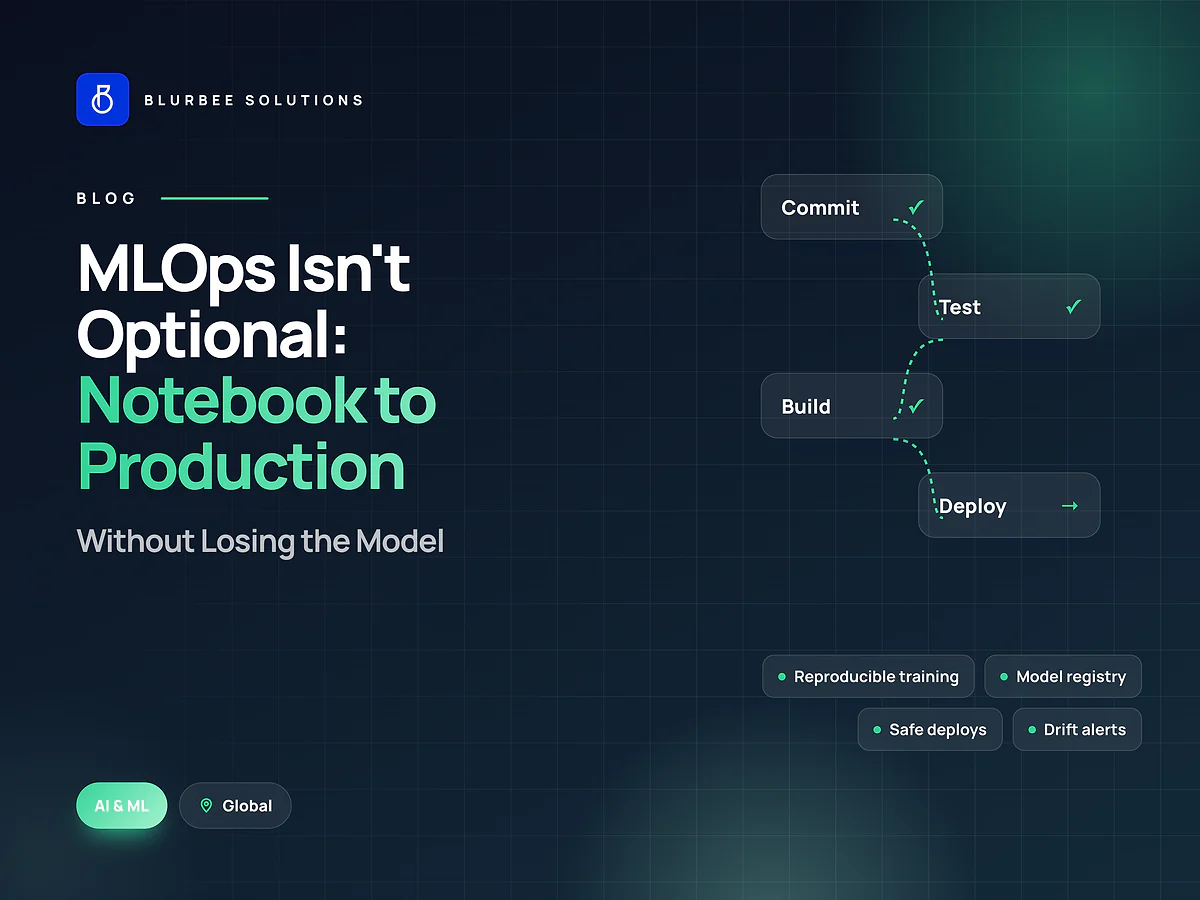
Runs AI in production: deployment, monitoring, cost control, model and prompt versioning, and security. Our article on MLOps from notebook to production explains this work.
Back-end and full-stack developers
Every AI feature still needs APIs, databases, authentication, user interfaces and tests. Strong Python developers are often the backbone of an AI team.
Research scientist
Develops new methods or models. Needed mainly when the model itself is your product or competitive advantage.
Skills that separate real AI engineers
When you interview, look past framework names. Strong AI engineers can:
- Design evaluation first. They build test sets from real examples and measure accuracy before and after each change.
- Explain trade-offs between prompting, RAG and fine-tuning for a given problem. Our article on fine-tuning vs prompting vs RAG covers these.
- Control cost and latency: model choice, caching, batching and token budgets.
- Handle failure: fallbacks, guardrails, human review and safe handling of wrong outputs.
- Work with messy data: cleaning, chunking, metadata and access permissions.
- Ship software: version control, tests, CI/CD, monitoring and security.
- Communicate uncertainty honestly to non-technical stakeholders.
Interview questions that reveal real experience
- "Tell me about an AI feature you put into production. What broke after launch, and how did you find out?"
- "How would you measure whether our document-search assistant is giving correct answers?"
- "When would you choose RAG over fine-tuning, and when neither?"
- "Our AI feature costs too much per request. What would you check first?"
- "How would you stop an agent from taking an action it shouldn't?"
- "How do you handle personal or confidential data in prompts and logs?"
Candidates who answer with specifics, such as numbers, failures and trade-offs, have usually done the work. Candidates who answer only with tool names usually haven't.
A short paid exercise on a realistic problem, such as evaluating a small RAG system against a set of questions, is far more revealing than algorithm puzzles.
What AI developers cost
In-house in the US: salary, plus benefits, recruiting fees, equipment, management time and the months it takes to hire. For senior AI engineers, total cost is substantially above the BLS median for software developers.
US agencies and consultancies: local agency bands published on our location pages typically run from $75 to $220 per hour.
Offshore teams:
| Market | Typical local agency rate (per hour) |
|---|---|
| United States | $75–$220 |
| United Kingdom | £45–£130 |
| United Arab Emirates | AED 120–420 |
| Canada | CA$60–175 |
| India | ₹800–3,600 |
Blurbee's published rates for AI and ML work are $30 to $60 per hour depending on seniority, and a typical AI engagement runs eight to sixteen weeks.
Hiring models compared
Full-time in-house. Best when AI is core to your product long term and you can attract and keep senior talent. Slowest to start; highest fixed cost.
Freelancers. Useful for short, well-defined tasks. Risky for production systems that need ongoing ownership, security and continuity.
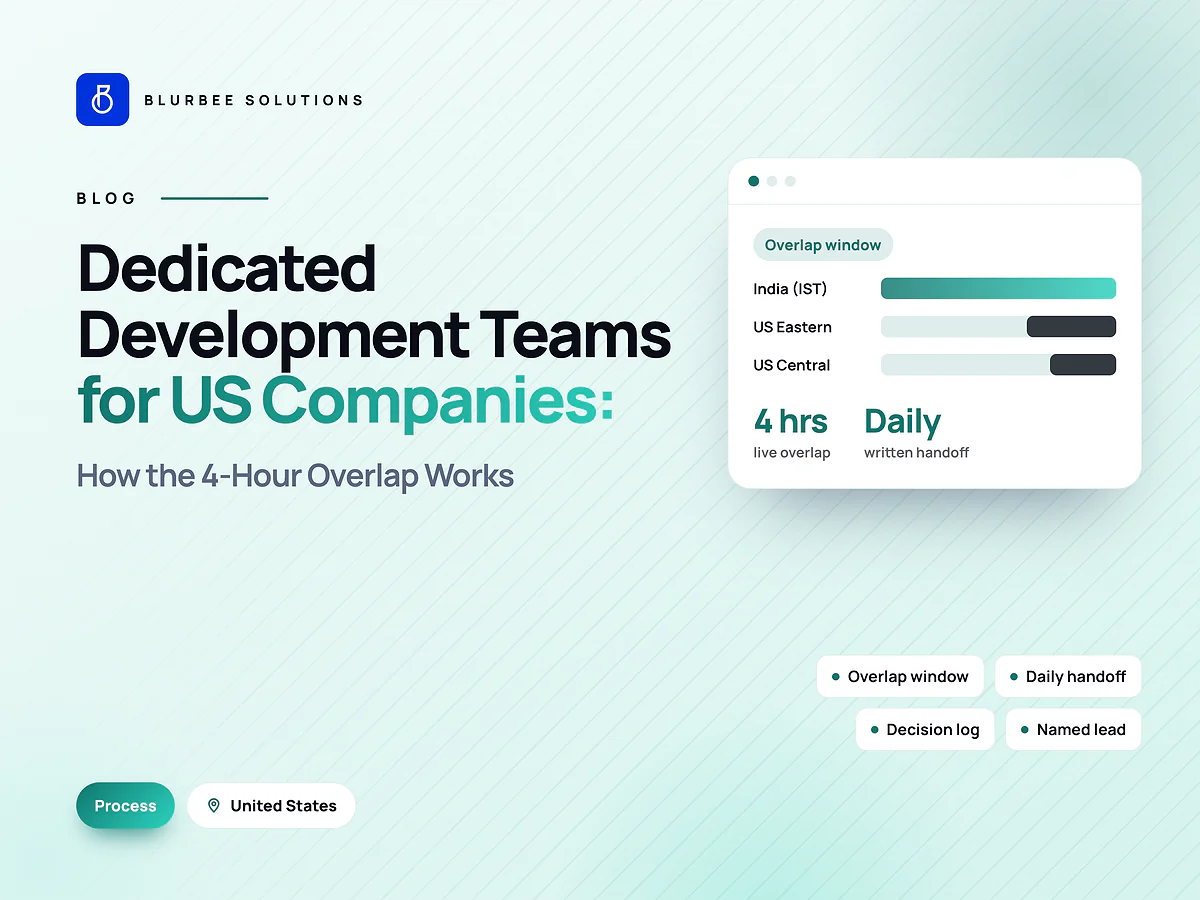
Dedicated offshore team. A stable team that works only on your product, with a delivery lead, at a predictable monthly cost. Fast to start and easy to scale. Our article on dedicated development teams for US companies covers this model.
Project-based partner. A partner delivers a defined AI outcome, such as a pilot, an agent or a RAG system, often at a fixed price per phase. Good for proving value before you hire in-house.
Many companies combine models: a partner proves the first use case, then a dedicated team or in-house hires take it forward, with knowledge transferred through documentation and pairing.
Red flags when hiring AI talent or partners
- Guaranteed accuracy before anyone has seen your data.
- No evaluation plan, only "we'll test it thoroughly".
- Demos without production experience.
- Proprietary platforms that lock in your prompts, data or workflows.
- No questions about your data quality, privacy or compliance.
- Every problem treated as needing a custom model. Often an existing model with good retrieval is better.
Making a remote AI team work
- Give them real data access early, with proper safeguards, because AI work depends on it.
- Agree on evaluation metrics before building.
- Use short iterations with demos on real examples.
- Keep decisions written down: prompts, model choices and evaluation results belong in version control.
- Plan overlap. With an India-based team, US companies usually get one to three and a half hours of live overlap each working day.
What to put in an AI job description
Vague job descriptions attract vague candidates. Be specific about:
- The problem: "Build a support assistant that answers from our help center and order system", not "work on AI initiatives".
- The stack: your cloud, languages, data platforms and any preferred model providers.
- The data: what exists, where it lives and how clean it is.
- Production expectations: evaluation, monitoring, cost targets and on-call responsibilities.
- Who they'll work with: product, data, engineering and compliance.
- How success is measured in the first six months.
A 30-day onboarding plan for AI engineers
- Week 1: access to code, data (with safeguards), documentation and the people who know the business problem.
- Week 2: build or review the evaluation set, with real examples and expected results agreed with the business owner.
- Week 3: first measurable improvement or prototype, run against the evaluation set.
- Week 4: review results, costs and risks with stakeholders, and agree the plan for the next quarter.
This works whether the engineer is in-house, a contractor or part of a partner's dedicated team. Evaluation, not enthusiasm, is the signal that someone is on the right track.
Retaining AI talent once you've hired it
Good AI engineers have options, so keeping them matters as much as hiring them:
- Give them real problems with real users, not endless demos and experiments.
- Invest in data foundations, because nothing frustrates AI engineers more than unusable data.
- Provide the right tools: model access, compute budgets and evaluation infrastructure.
- Share results so they see the business impact of their work.
- Support learning, since the field changes every few months.
- Pair them with domain experts who can explain the business and judge outputs.
If you work with a partner's dedicated team, ask how they keep people on your account, and insist on documentation so knowledge stays with you even if people change.
Key takeaways
Most companies need applied AI engineers, data engineers and solid software developers before research scientists. Test candidates on evaluation, trade-offs, cost control and production experience with a realistic paid exercise. Choose a hiring model, or a mix, that matches how central AI is to your product. Insist on ownership of code, prompts and evaluation sets.
Hiring AI developers through Blurbee
Blurbee provides AI engineers, ML engineers, data engineers and full-stack developers to US companies, as a dedicated team or a project, with a named delivery lead. We sign an NDA first, and code, prompts and IP are assigned to you in writing. See hire AI and ML developers for US teams, our AI and ML development services, and developer hiring across the USA.