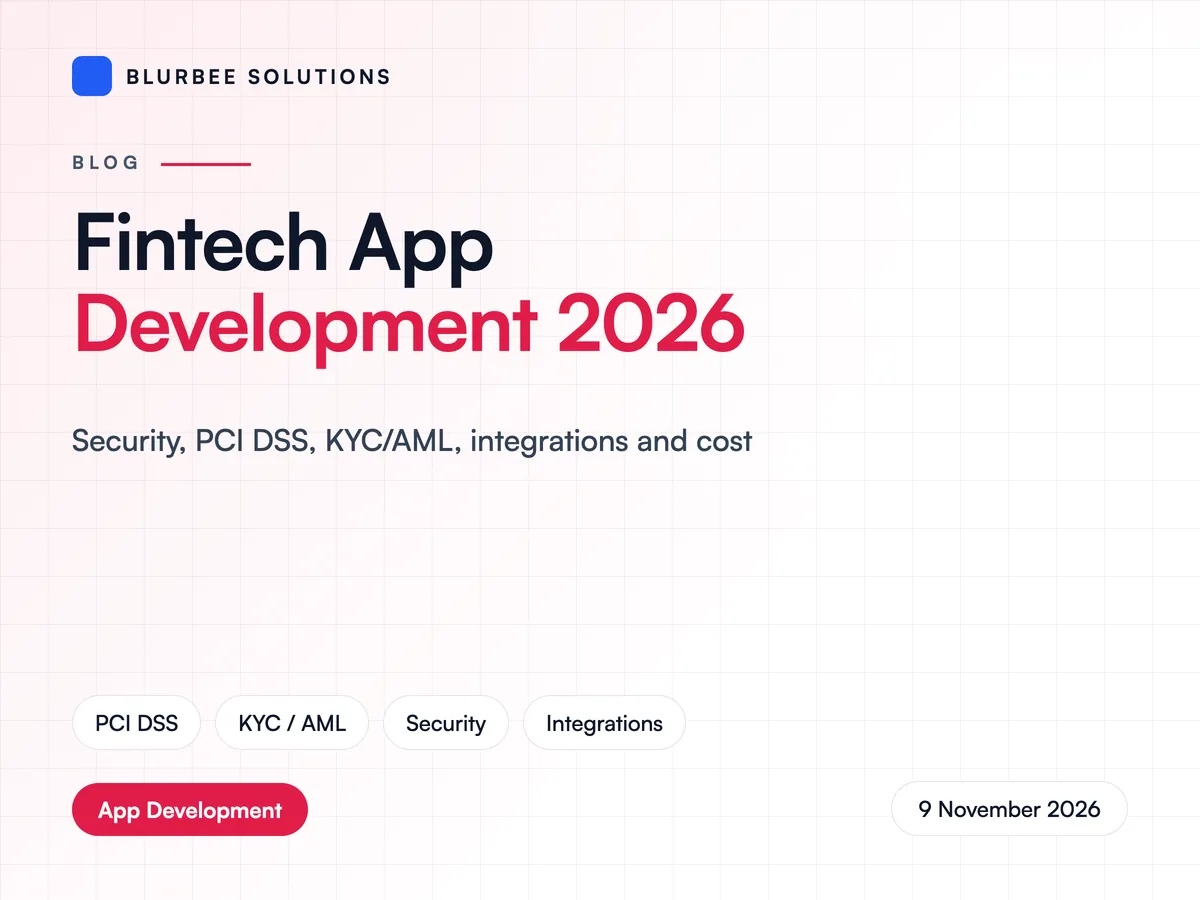
Fintech App Development in 2026: How to Build a Secure, Compliant Financial App
A practical guide for US fintech founders and financial teams: core features, the compliance you can't skip, security architecture, integrations and what drives cost.

Financial apps carry a burden most software doesn't: users trust them with their money and their identity, and regulators expect proof that the trust is deserved. A bug in a social app is an annoyance. A bug in a payments app can mean lost funds, regulatory action and a brand that never recovers.
This guide covers what it takes to build a fintech app in the United States in 2026: the features, the compliance, the security architecture and what drives cost.
This is general guidance, not legal or regulatory advice. Fintech regulation depends on what your product does and where, so involve qualified compliance counsel early.
Why security comes first
Breaches are costly, and US costs are the highest in the world. IBM's Cost of a Data Breach Report 2025 found the global average breach cost $4.44 million, while the US average rose to $10.22 million (IBM). Financial services is consistently among the most expensive industries.
For card payments, the bar has also risen. PCI DSS version 4 added 64 new requirements, 51 of which were future-dated and became effective on 31 March 2025 (PCI Security Standards Council). Any app that stores, processes or transmits cardholder data, or can affect its security, must meet them.
Common types of fintech app
- Payments and money transfer: peer-to-peer payments, merchant payments, invoicing and payouts.
- Digital banking and neobanks, usually built with a sponsor bank and banking-as-a-service provider.
- Lending: consumer loans, buy now pay later, small business lending and loan servicing.
- Personal finance and budgeting: account aggregation, insights and savings tools.
- Wealth and investing: brokerage, robo-advice and portfolio tools.
- Insurtech: quoting, policy management and claims.
- B2B finance: expense management, accounts payable automation and treasury tools.
Each carries different regulatory obligations, so define exactly what your product does before designing it.
Core features most fintech apps need
- Secure onboarding with identity verification (KYC) and, for businesses, KYB.
- Strong authentication: multi-factor authentication, biometrics and device binding.
- Account linking through open-banking or aggregation providers.
- Payments and transfers through processors, card networks, ACH or real-time payment rails.
- Transaction history, statements and notifications.
- Fraud detection and transaction monitoring.
- Customer support with secure messaging and a clear route to a human.
- Admin and compliance tools for your operations team: case management, reviews and reporting.
The compliance landscape
The rules depend on your product, but these come up most often for US fintech apps:
- PCI DSS for any handling of payment card data. The simplest way to reduce scope is to never let card numbers touch your servers, using a processor's hosted fields or tokenization.
- KYC and AML under the Bank Secrecy Act: verifying customers, screening against sanctions lists (OFAC) and monitoring for suspicious activity. Often handled with a sponsor bank and specialist providers.
- Consumer protection rules from the CFPB, including those on electronic fund transfers and lending disclosures where they apply.
- Privacy: the Gramm-Leach-Bliley Act for financial institutions, plus state privacy laws such as California's CCPA.
- State licensing, such as money transmitter licenses, unless you operate under a licensed partner.
- SOC 2 reports, which banks and enterprise customers usually expect from vendors.
Your architecture should make compliance evidence easy to produce: audit logs, access records, change history and documented controls.
Security architecture that holds up
- Minimize sensitive data. Tokenize card data with your processor; store only what you need.
- Encrypt everything in transit and at rest, with careful key management.
- Least-privilege access for staff and services, with strong authentication and regular access reviews.
- Separate environments, and never use real customer data in development or testing.
- Immutable audit logs for transactions, account changes and admin actions.
- Secure development practices: code review, dependency scanning, secrets management and threat modeling for new features.
- Penetration testing before launch and regularly after.
- Fraud controls: velocity limits, device fingerprinting, anomaly detection and step-up authentication for risky actions.
- Resilience: backups, disaster recovery and tested incident response.
Build or partner: the fintech stack
Few fintech apps build everything. The usual pattern is to partner for regulated infrastructure and build the customer experience:
- Banking-as-a-service and sponsor banks for accounts and cards.
- Payment processors for card acceptance and payouts.
- Identity verification and KYC providers.
- Open-banking and account aggregation providers.
- Fraud and transaction-monitoring tools.
What you build is the product your customers see, your business logic, and the integration and operations layer that ties partners together. Choose partners carefully. Their reliability, pricing and compliance posture become yours.
AI in fintech
AI is increasingly used for fraud detection, credit decisioning support, document processing, customer support and personalized insights. In finance it needs extra care: explainability for decisions affecting customers, fair lending considerations, model monitoring and human review. Our article on AI and ML consulting for US healthcare and fintech covers these issues.
What drives fintech app cost
- Product type and regulatory scope: a budgeting app costs far less than a lending or banking product.
- Number of integrations: processors, banking partners, KYC, aggregation and fraud tools.
- Platforms: web, iOS and Android.
- Security and compliance work: architecture, audit logging, testing, documentation and penetration tests.
- Admin and operations tools, which are often as large as the customer app.
- Partner fees, which are ongoing running costs.
Blurbee's published rates are $24 to $48 per hour for mobile app development and $22 to $45 for web development, depending on seniority. A typical app engagement runs eight to eighteen weeks; fintech products usually sit toward the upper end because of security and compliance work, and larger products are delivered in phases. Our mobile app development cost guide covers budgeting in more depth.
A phased plan
- Discovery and compliance scoping: product definition, regulatory analysis with counsel, partner selection and data-flow mapping.
- Architecture and security design: threat model, infrastructure, audit and access controls.
- MVP build: onboarding, core transaction flow and admin tools, integrated with sandbox partner environments.
- Security testing and compliance review, including a penetration test.
- Limited launch with transaction limits and close monitoring.
- Scale: more features, higher limits and additional partners.
Our MVP development guide explains how to keep the first release focused.
Questions to ask a fintech development partner
- Have you integrated with payment processors, banking partners and KYC providers?
- How do you keep card data out of scope for PCI DSS?
- How do you design audit logging and access control?
- How do you handle secrets, keys and production access?
- What security testing is included before launch?
- What documentation will we receive for compliance reviews and SOC 2?
Designing onboarding that converts and complies
Onboarding is where fintech apps lose most users, and where compliance is most visible. Balance the two:
- Explain why you need each piece of information, especially Social Security numbers and documents.
- Ask only what's required for the user's current level of access, and collect more as they unlock higher limits.
- Make document capture easy with clear instructions, automatic capture and immediate feedback on blurry images.
- Show progress so users know how many steps remain.
- Handle failures kindly: tell users what to fix, and give them a way to reach a person.
- Save progress, so a dropped connection doesn't mean starting again.
- Test with real users on a range of devices, including older phones.
The operations tools you'll need
The customer app is only half the product. Your team will also need:
- A back-office dashboard to view customers, accounts and transactions.
- Case management for KYC reviews, fraud alerts and disputes.
- Role-based admin access with full audit trails.
- Reporting for finance, compliance and partners.
- Customer support tools with secure access to the right information.
- Controls for limits, holds and account restrictions.
Plan these from the start. Building them as an afterthought is one of the most common reasons fintech launches slip.
Testing a fintech app before launch
Financial apps need more testing than most:
- Functional testing of every money movement, including failures, reversals, refunds and duplicates.
- Reconciliation testing, confirming your records match your processor's and bank partner's exactly.
- Security testing: penetration testing, authentication and session handling, and checks for common vulnerabilities.
- Load testing for peak periods such as payday or month-end.
- Device and accessibility testing across phones, operating system versions and assistive technologies.
- Partner sandbox testing, then limited live testing with small amounts and internal users.
Launch with transaction limits and close monitoring, and raise limits as evidence builds.
Key takeaways
Define your product's regulatory scope early with counsel, and partner for regulated infrastructure such as banking, payments and KYC. Keep card data out of scope with tokenization, design security and audit logging in from the first sprint, and build operations tools alongside the customer app. Test thoroughly and launch with limits.
Building fintech apps with Blurbee
Blurbee builds web and mobile applications for US companies with security designed in from the first sprint: tokenized payments, strong authentication, audit logging, encryption and synthetic test data. We work alongside your compliance counsel and partners, and the code and IP are yours. See our mobile app development services, app development across the USA and our New York City app development page.