Development Partners for Quebec and Atlantic Canada: Bilingual Delivery
What French-language and bilingual product delivery actually requires, plus how Atlantic Canada businesses access senior engineering capacity affordably.

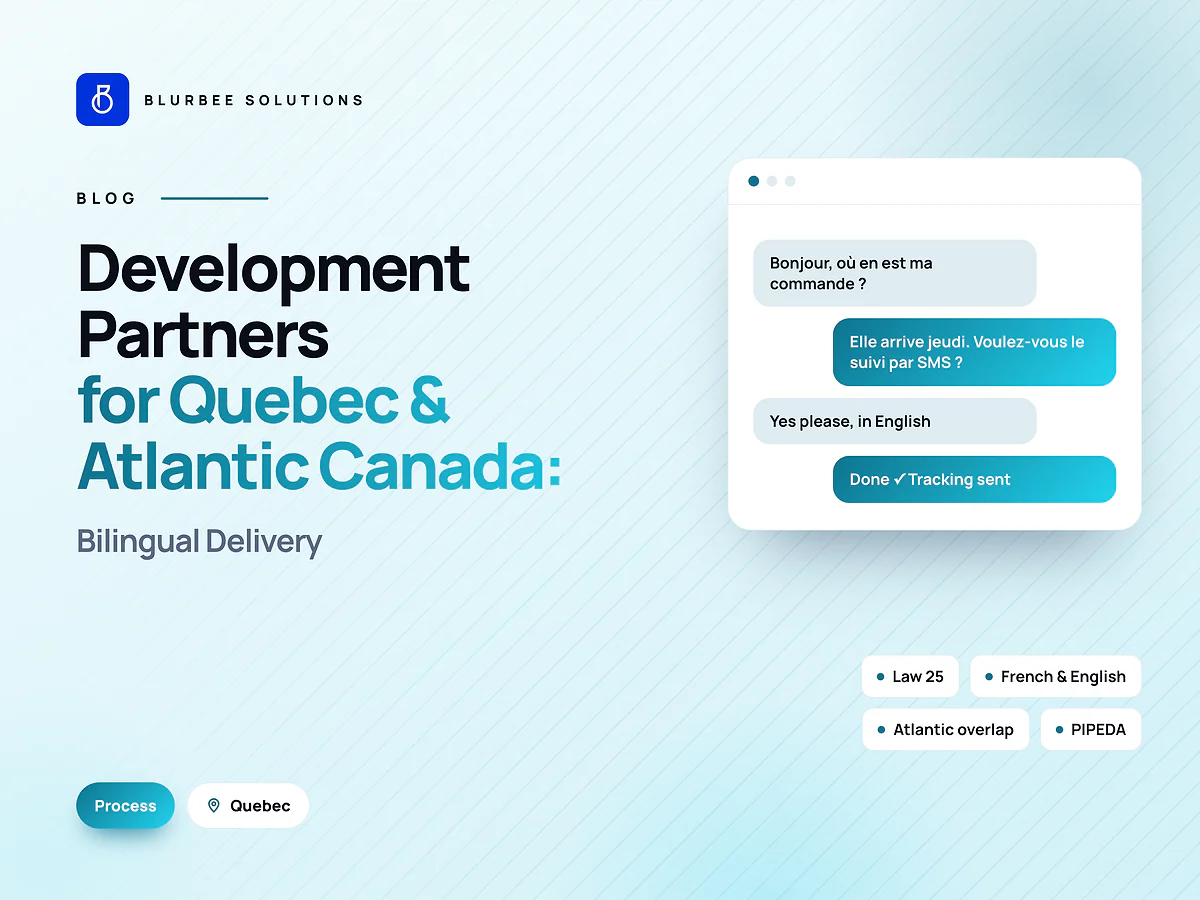
Bilingual delivery in Canada fails in a predictable way: the product gets built in English, translation is scheduled for the end, and then somebody discovers that half the interface text is hardcoded in components, the navigation breaks when French expands it by a third, and the emails are English-only.
The fix is not better translators. It is deciding the architecture in week one.
Quebec: two separate obligations
It is worth separating them, because they are often conflated.
The Charter of the French Language, strengthened by Law 96, requires that customer-facing software, interfaces and documentation be available in French, with French at least as prominent as any other language. If you serve Quebec consumers, this is a product requirement.
Law 25 is the privacy regime, and it is the strictest in Canada. Its requirements with real engineering consequences:
Granular, purpose-specific consent — not a single blanket checkbox. A designated privacy officer, named. Privacy impact assessments before deploying new systems that handle personal data, which means the assessment is part of the project plan rather than a review at the end. Breach reporting to the Commission d'accès à l'information. Data portability on request, in a structured, commonly used technical format — which is a real feature someone has to build. And disclosure where automated decision-making is used, including the right to have it explained.
Portability and the PIA are the two most often underestimated. Portability is an export feature with a data-model dependency. The PIA is a document that has to be produced before deployment, which means the information it needs has to be captured during the build.
What bilingual architecture actually means
Five decisions, all made before significant UI exists.
Externalised strings. No text hardcoded in components. Every user-visible string in a resource file with a key. This sounds obvious and is violated constantly, usually in error messages, validation text, email templates and PDF documents — the places nobody remembers until translation begins.
Layouts that survive expansion. English to French typically expands text by 30-40%. Buttons, navigation items, table headers and any fixed-width element designed around English will break. Test with the longest expected string, not with placeholder text.
Locale-aware formatting. Dates, numbers, currency. Quebec French uses different conventions from English Canada, and getting this wrong is the kind of detail that signals the product was not really built for the market.
Language persistence everywhere. The user's choice has to be respected in the interface, in transactional emails, in generated documents and PDFs, and in support interactions. Emails are the most commonly missed.
URL structure supporting both languages, for SEO and for shareability. Decide the pattern early — path prefix is usually simplest — and set hreflang accordingly.
Do not machine-translate the interface
For anything customer-facing in Quebec, machine translation is not adequate. Interface French has conventions that automated translation gets wrong in ways that read as careless, and in Quebec carelessness about French carries real commercial cost.
Our approach: build the architecture so professional translation drops in cleanly, then recommend a Quebec-based reviewer for the final pass. The architecture is our job; the language quality needs someone for whom it is their job.
Why retrofitting costs what it does
A bilingual retrofit touches nearly every view. Hardcoded strings have to be found across the entire codebase, including in places nobody documented. Layouts break where they were designed around English. Fixed-width elements need reworking. Email and document templates need parallel versions.
In practice this is roughly the cost of rebuilding the front end. Not impossible, and occasionally the right decision — but the reason we push the week-one conversation so hard is that the alternative is a bill nobody budgeted for.
New Brunswick: officially bilingual
New Brunswick is Canada's only officially bilingual province. English and French parity is the baseline expectation in provincial work and in most business serving the province.
The requirements are less prescriptive than Quebec's Charter, but the practical expectation is identical: both languages, equally good, at the same time. A product that treats French as the secondary version will be noticed.
Atlantic Canada: the capacity problem
The senior engineering pool in Halifax, Moncton, St. John's and Charlottetown is genuinely small. That leaves three options:
Remote Canadian hires, competing with Toronto and Vancouver salaries for the same people. Viable and expensive.
Regional agencies, at roughly CA$80-130 per hour — cheaper than Toronto, with the constraint that the deepest specialist experience is thin.
Offshore extension, at CA$33-66 blended including QA and a delivery lead.
The overlap arithmetic favours Atlantic Canada more than anywhere else in North America. Atlantic time gives four hours of live overlap, 09:30-13:30 AT. Newfoundland gets four hours at 10:00-14:00 NT. That is the widest window we have with any North American region, and it makes the working relationship materially easier than it is with Pacific clients.
Sector notes
Halifax ocean technology. Sensor and telemetry work rather than conventional business applications. Data volumes are high, the interesting problems are in ingestion and analysis, and the interface is usually the smallest part.
Newfoundland offshore energy. Satellite-only connectivity and severe weather downtime. Software must tolerate long disconnections and resume cleanly — offline-first architecture, queued writes, conflict resolution. And it must be tested against genuine link degradation, high latency and packet loss, not simply a disabled network toggle.
New Brunswick cybersecurity. A real cluster, which means clients arrive with a security-first brief and an in-house reviewer. That is a good thing: the questions are better and they come early.
PEI. Small enough that provincial programmes and private clients often share the same handful of stakeholders. Reputation travels quickly in both directions.
Privacy across the Atlantic provinces
PIPEDA applies federally for commercial activity in all four — none has a substantially similar private-sector provincial act. Health information is covered by separate provincial statutes in each province, and those are worth a specific legal read if your product touches health data.
If you serve Quebec customers from an Atlantic base, Law 25 applies to that processing regardless of where you sit.
How to start with bilingual work
A fixed-scope first project of two to four weeks, and for bilingual work specifically we recommend making it one complete flow built properly in both languages — sign-up, or a core transaction, end to end including the confirmation email.
That proves the architecture works, surfaces the layout problems while they are cheap, and gives you a template that everything afterwards follows. It is the cheapest possible way to find out whether the approach holds.
What bilingual and Law 25 work adds
Standard time. Daylight saving shifts each window by an hour without changing its length.
Why Quebec and Atlantic teams work with Blurbee
We treat bilingual delivery as a content architecture decision made in week one, not a translation pass bolted on at the end — and we scope Law 25's privacy impact assessment and portability duties as real work rather than a policy page.
- Fixed-scope first projectTwo to four weeks, priced as a number rather than an estimate, so you have evidence before a longer commitment.
- One delivery lead, namedYou always know who to ask. No account manager relaying questions to a team you never meet.
- Code and IP are yoursAssigned in writing, handed over with repositories, infrastructure definitions and documentation whether or not you continue with us.
- Performance budgets in CICore Web Vitals and bundle size gate the build. Slow does not ship.
- Accessibility to WCAG 2.2 AAReviewed with automated and manual passes, not claimed on a slide.
- Written overlap disciplineStanding calls inside your working window, everything else asynchronous with a decision log.