Choosing a Global Software Development Partner: The Complete 2026 Guide
The pillar guide to selecting a development partner across India, the US, UK, UAE and Canada: models, pricing, contracts, IP, security review and delivery risk.

Choosing a development partner is mostly a process of eliminating the ways this goes wrong, because the ways it goes right are fewer and more boring. This guide covers the decisions in the order they actually arise.
We compete for the work described here, so read it with that in mind. Where the honest answer is that a local agency suits you better, it says so.
Start with the question nobody asks
Before comparing vendors: who on your side answers product questions, and how fast?
This is the strongest single predictor of outcome, and it is almost never in a selection framework. Partners amplify whatever clarity exists. A decisive counterpart gets good work out of a mediocre partner. An absent one gets poor work out of an excellent partner, then concludes the partner was the problem.
If the answer is "the founder, who is also running sales," a distributed arrangement will be harder than it looks. Not impossible — but you will need to batch decisions and write more down than feels natural, and it is better to know that now.
The four engagement models
Fixed price, fixed scope. Correct when the specification is genuinely settled: a defined set of screens, a known integration, a rebuild of something documented. Fails when discovery is required, because the vendor must price the unknown. They will either pad the number or protect margin later by quietly reducing quality. Watch for the second — it appears as QA vanishing from the plan around week eight.
Time and materials. Honest for exploratory work, dangerous without a cap. Insist on a weekly hour ceiling and a written change-approval step, or your budget becomes a monthly negotiation rather than an agreed figure.
Dedicated team. Right when you have continuous work and someone internally setting direction. Expensive when you do not, because you pay for capacity waiting on your approvals. The failure mode is a team idle pending decisions.
Discovery then build. A fixed-price discovery phase producing a real specification, then a fixed price for the build against it. This is what we recommend for a first engagement with anyone: a small, bounded amount at risk to remove the largest source of estimating error.
Rates across markets, and the honest comparison
Blended mid-to-senior rates, converted to USD:
United States $75-185, higher on the coasts. Canada $60-120. United Kingdom $57-140, with London at the top and regional cities 35-45% below it. United Arab Emirates $35-110. India $18-60.
The gap is real. The comparison most buyers get wrong is stopping there.
Add your own management time: four to six hours a week for a well-run distributed engagement, spent on written briefs, a standing call and reviewing work. If your time is the scarce resource, that is a genuine cost.
Then add the thing nobody models: total cost of ownership over the first year. A cheaper build that generates two months of rework, needs a specialist to maintain, and cannot be handed to a new developer without a rewrite is not cheaper. Ask any prospective partner how they would onboard a developer who did not build the system. The answer tells you whether documentation exists.
The three documents, and the four things that matter more
An NDA, before you describe the brief in detail.
A master services agreement with explicit assignment of all work product — code, designs, documentation — to you on payment. Read this clause specifically. Silence, or ownership reserved to the vendor with a licence back to you, means you do not own your product.
A data processing agreement with subprocessor disclosure, where personal data is involved. Name every service the data passes through. Gaps usually appear in error tracking and observability tools that capture request payloads.
Now the practical measures, which matter more than any of it:
Your repositories. Your GitHub or GitLab organisation, with the vendor's engineers as members.
Your cloud accounts. Your AWS, GCP or Azure, your secret store.
Your domain registrar and app store accounts.
Milestone payments, so you are never far ahead of delivered work.
Cross-border enforcement is slow and expensive. Structure beats litigation: code and infrastructure in your accounts cannot be held hostage, and a short first project means a bad fit costs weeks rather than quarters.
Security review, whoever you pick
Establish before signing: how credentials are stored — a managed secret store, or environment files in a repository? Whether engineers work on company-managed devices with disk encryption. What access is granted to whom, and how it is revoked at offboarding. Who the subprocessors are. Whether the partner has completed a client security questionnaire before, and can show you a redacted one.
Send your questionnaire in week one, not at contract stage. A question a partner cannot answer honestly is far better discovered early.
A partner who has never seen these questions is not disqualified. One who is annoyed by them is.
Regional constraints worth knowing before you shortlist
United States. California's CCPA/CPRA is the practical baseline; Colorado and Texas require universal opt-out signal support; Illinois BIPA is the strictest biometric statute in the country. Export-controlled and federal work generally rules out offshore delivery entirely — establish this on the first call.
United Kingdom. UK GDPR requires an Article 28 DPA plus a lawful transfer mechanism for India — the IDTA or the UK Addendum — and a documented transfer risk assessment. PECR makes cookie consent stricter in practice than most sites implement.
Canada. PIPEDA federally; BC and Alberta have provincial PIPAs that displace it; Quebec's Law 25 is the strictest regime in the country and adds privacy impact assessments and data portability. Public-sector and health data frequently carries residency requirements.
United Arab Emirates. Federal PDPL, with DIFC and ADGM operating their own regimes inside the financial free zones. Government-linked entities generally require in-country hosting and vendor registration before technical discussion.
India. The DPDP Act 2023 governs consent and purpose limitation; RBI guidance drives payment data localisation; public-sector work triggers CERT-In and MeitY requirements.
How to actually evaluate
Ask what went wrong on a comparable project. Every real project has something. A partner who cannot name theirs has either not shipped much or is managing you.
Read one pull request in week two. Insist work arrives as PRs rather than bulk deliveries. If nobody on your side reads code, buy two hours of an independent senior contractor's time.
Speak to the engineers by name. Not to test them in an hour, but to confirm they exist, know your project, and are the people you are paying for.
Ask for a client who did not renew. The answer, or the refusal, is informative.
Check the assumptions section. A proposal that does not state what it assumed is a guess with a number attached.
The red flags
Roughly in order of severity: no written IP assignment; full payment demanded up front; a portfolio where every item carries identical tags and none links to a case study; testimonials with no attributable name or company; a detailed quote within an hour of a first conversation; bundled hosting or licences at an undisclosed margin; no QA, accessibility or performance line item; reluctance to introduce the engineers.
No single one is proof. Three or more together usually is.
Overlap: hours matter less than discipline
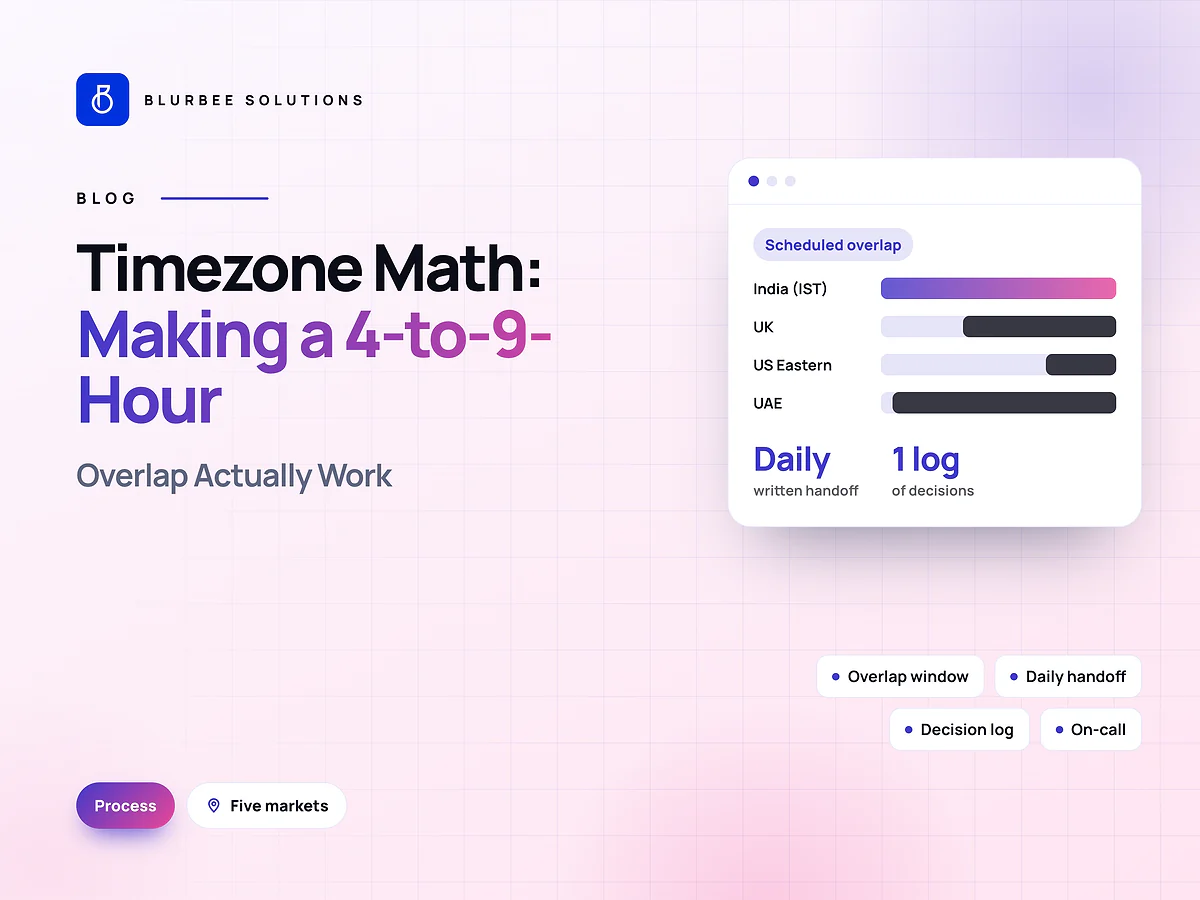
Ninety minutes is enough if two documents exist.
An end-of-day handoff: what moved, what is blocked and on whom, what needs a decision from you, what is next. Five minutes to write, and it converts a time difference into overnight progress you can act on.
A decision log: every material decision, dated, with reasoning and alternatives. Across a time difference, "we agreed that on a call" is not a record.
Teams with four hours of overlap and neither document perform worse than teams with ninety minutes and both.
One further point: do not ask an offshore team to work your hours. A team working past midnight to accommodate your afternoon meetings leaves within two quarters, and you pay for that in turnover and lost context.
The trial project
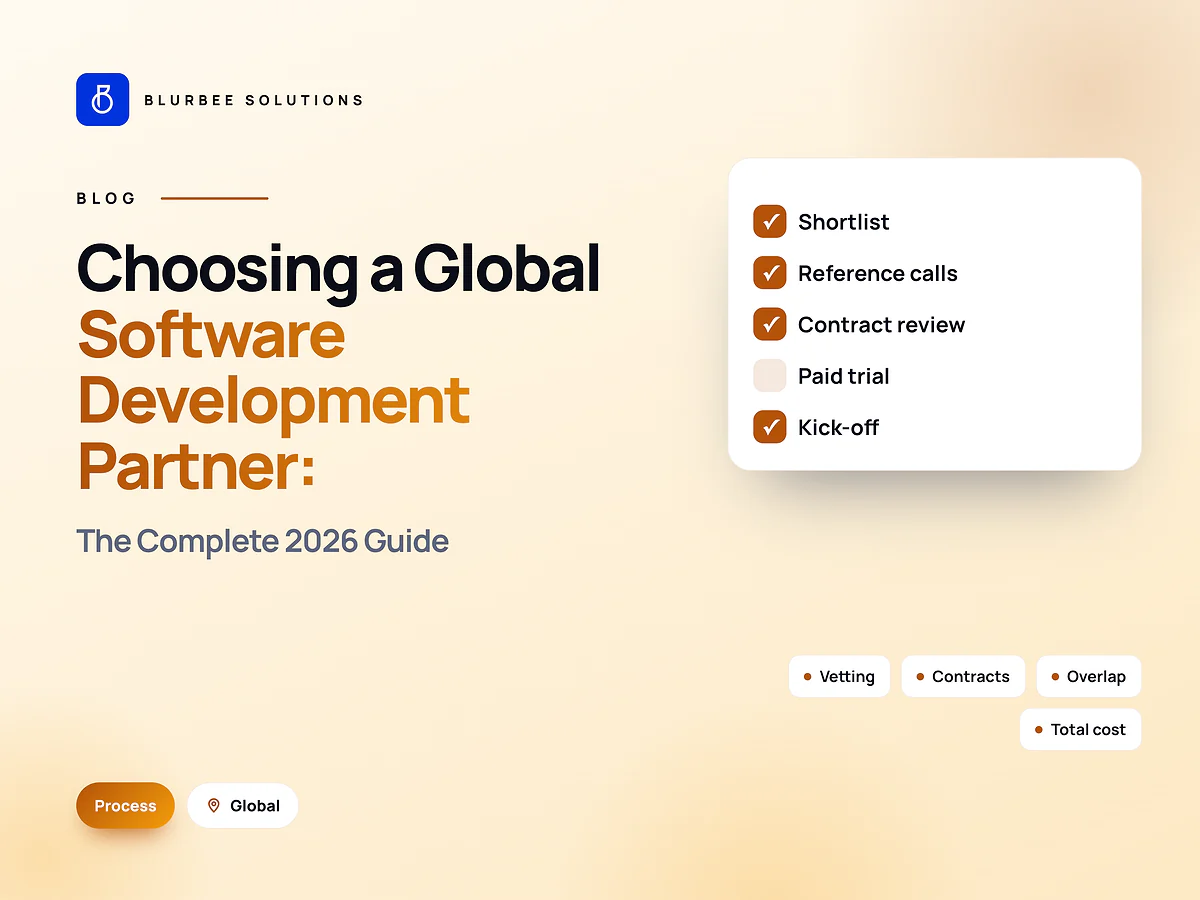
Two to four weeks. Fixed scope. One real feature or integration — not a throwaway. Your repository, your accounts, milestone payment.
At the end you have working software and direct evidence about estimating accuracy, code quality, communication, and what happens when something slips. That last one is the most valuable and the hardest to obtain any other way.
If it goes badly you lost weeks. If it goes well you have a partner who already understands your codebase.
We recommend this to every prospective client, including ones who would rather start large. The information is worth more than the time it costs.
When to walk away from offshore entirely
Four cases, stated plainly.
When nobody internally can set product direction — the team will build what it guessed.
When the work carries export-control, ITAR or citizenship restrictions.
When your operating style genuinely requires someone reachable in your afternoon. That is a legitimate requirement, not a failing, and a local agency or nearshore team is the better answer.
When the project is small, bounded and unlikely to recur. That is a local contractor job, and treating it as a partnership adds overhead to both sides.
The decision, in numbers
Composite of published regional rate cards, 2026, converted to USD at prevailing rates. Indicative bands; seniority, contract length and scope move them materially.
Why we wrote this the way we did
We compete for the work this guide is about, and everything here is what we would want to know if we were the buyer. Where the honest answer is that a local agency suits you better, it says so.
- Fixed-scope first projectTwo to four weeks, priced as a number rather than an estimate, so you have evidence before a longer commitment.
- One delivery lead, namedYou always know who to ask. No account manager relaying questions to a team you never meet.
- Code and IP are yoursAssigned in writing, handed over with repositories, infrastructure definitions and documentation whether or not you continue with us.
- Performance budgets in CICore Web Vitals and bundle size gate the build. Slow does not ship.
- Accessibility to WCAG 2.2 AAReviewed with automated and manual passes, not claimed on a slide.
- Written overlap disciplineStanding calls inside your working window, everything else asynchronous with a decision log.