AI Development Cost in 2026: What Chatbots, RAG, AI Agents and Custom Models Really Cost
AI projects have two price tags: the build and the monthly bill. This guide covers both for the four kinds of AI work companies commission most.

Most AI quotes cover the build and say little about what it costs to run, evaluate and maintain. Yet the running cost is what finance will ask about six months after launch. This guide breaks down both for the four kinds of AI work we are asked for most: chatbots and assistants, retrieval-augmented generation (RAG), AI agents and custom models.
The two price tags
Build cost is the engineering effort: discovery, data preparation, integration, user interface, evaluation and deployment. It is driven by hours and rates.
Running cost is what you pay every month once it is live: model or inference fees, hosting, vector storage, monitoring and the people who review answers and keep the system accurate.
A system that is cheap to build but expensive to run is a bad deal, and so is the reverse. Ask for both numbers before you commit.
1. AI chatbots and assistants
A support or sales assistant that answers from a fixed set of instructions and calls a few tools is the smallest AI build. The main work is conversation design, guardrails, hand-off to a human and integration with your help desk or CRM.
- Build drivers: number of intents and tools, languages, channels (web, WhatsApp, app) and the level of testing.
- Running drivers: conversation volume, model choice and how much context each message carries.
2. RAG: answering from your own documents
RAG lets a model answer from your knowledge base, contracts, manuals or tickets. The build includes ingesting and chunking documents, embeddings, a vector store, retrieval tuning and, most importantly, an evaluation set that proves the answers are right.
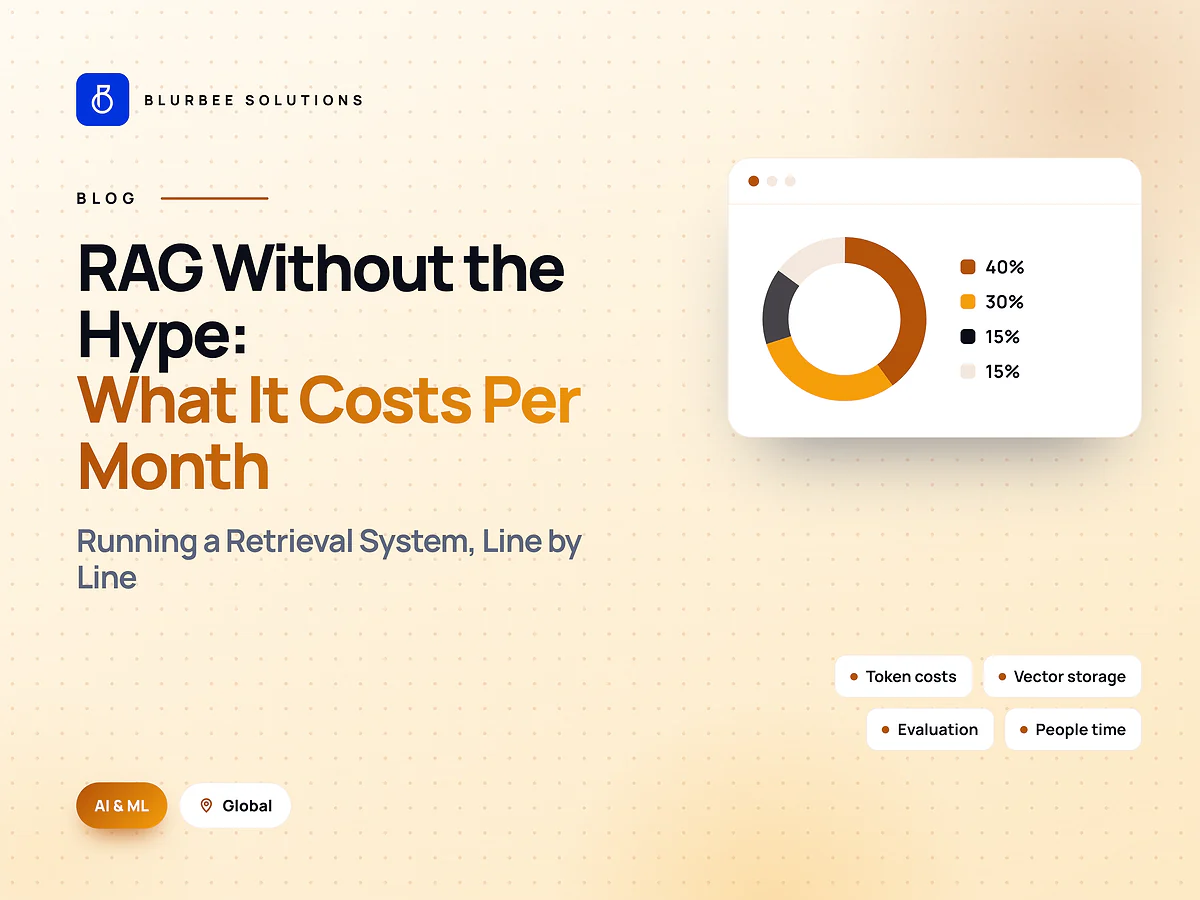
Running costs are usually modest for internal tools, and the largest line is often the people who review answers and update content. We break the monthly bill down line by line in what a RAG system costs to run.
3. AI agents
Agents plan and take actions: reading email, updating records, drafting documents, calling APIs. They are more valuable and more expensive than chatbots because every action needs permissions, error handling, logging and a way for a person to approve or undo it.
- Build drivers: the number of systems the agent touches, how risky its actions are and how much human review is required.
- Running drivers: the number of steps per task and the model used for each step.
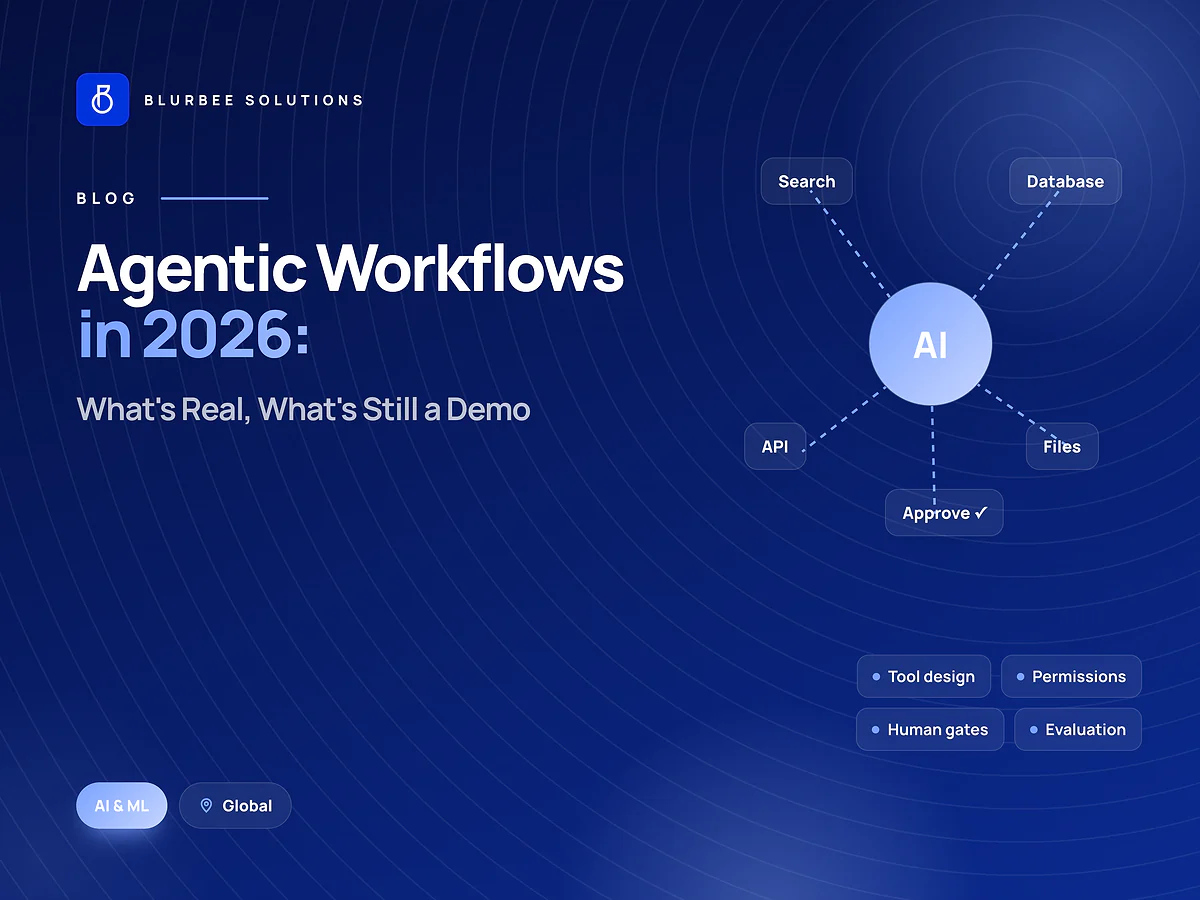
Start agents on low-risk, high-volume tasks with a human approving the output, then widen their authority as accuracy is proven. Our agentic AI workflows article covers the patterns that work.
4. Custom and fine-tuned models
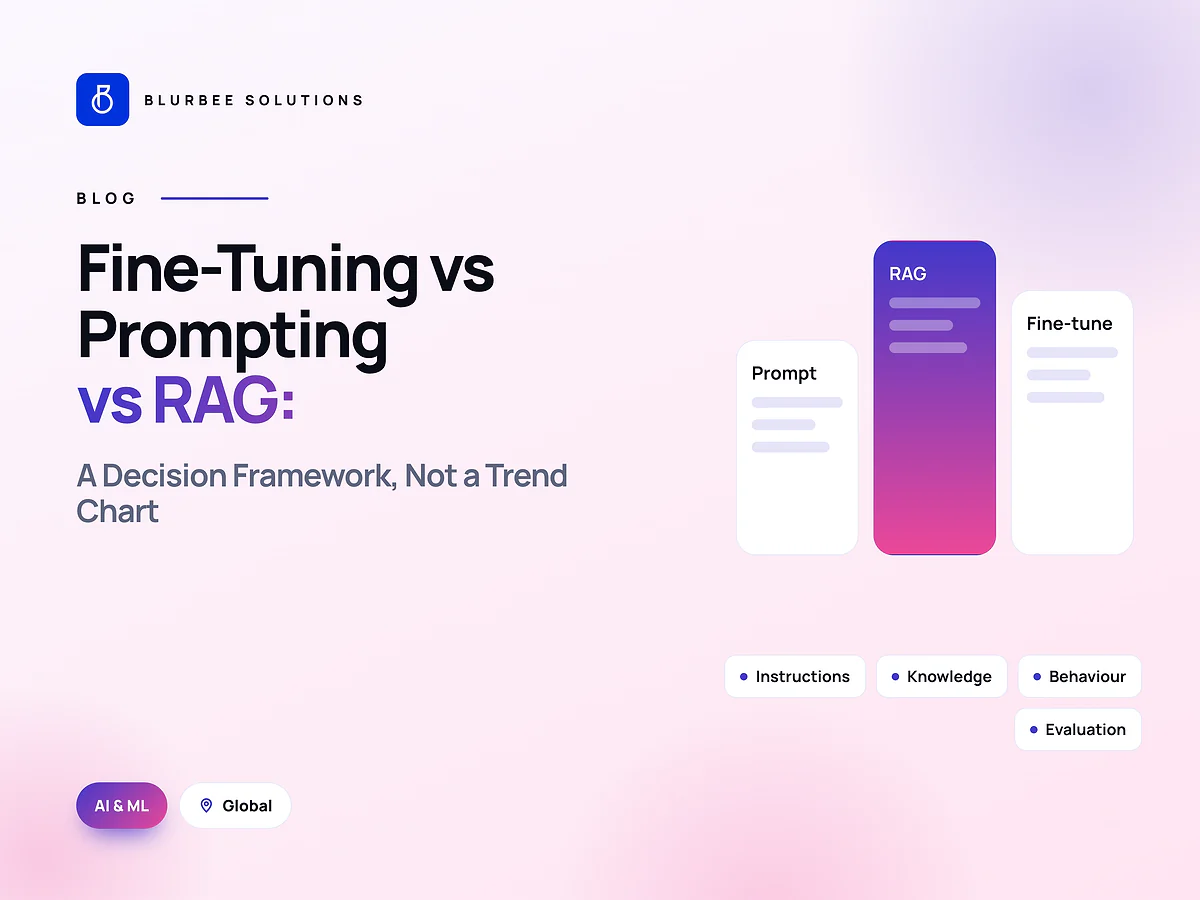
Training or fine-tuning a model makes sense when prompting and RAG cannot reach the accuracy, latency or cost you need, for example classification at high volume, document extraction in a narrow domain or on-device inference. Costs include data labelling, training runs, evaluation and the infrastructure to serve the model. Read fine-tuning vs prompting vs RAG before you commit to this path.
Timelines and rates
A typical AI and ML engagement at Blurbee runs eight to sixteen weeks from discovery to production, and our AI and ML rates are $30 to $60 per hour depending on seniority. Local agency rates for comparable work, as published on our location pages:
| Market | Typical local agency rate (per hour) |
|---|---|
| United States | $75–$220 |
| United Kingdom | £45–£130 |
| United Arab Emirates | AED 120–420 |
| Canada | CA$60–175 |
| India | ₹800–3,600 |
What makes AI projects overrun
- No evaluation set. Without a fixed set of test questions and expected answers, nobody can tell whether a change made things better or worse.
- Messy data. Duplicate, outdated or contradictory documents produce confident wrong answers.
- Unclear ownership. Someone in the business must own accuracy after launch.
- Scope creep. "Can it also do this?" is easy to ask and expensive to support.
- Ignoring privacy. Personal or regulated data needs the right hosting, access controls and data-processing terms from the start.
How to keep AI costs under control
- Pick one use case with measurable value, such as hours saved per week or tickets deflected.
- Prove it with a fixed-scope pilot of two to four weeks before building the full system.
- Build the evaluation set first and run it on every change.
- Choose the smallest model that passes the evaluation, and route only hard cases to larger models.
- Set budget alerts on model and hosting spend before launch.
- Keep your data and code in your own accounts so you can switch models or vendors later.
Build, buy or combine?
Not every AI need requires a custom build:
- Buy an off-the-shelf tool when the use case is generic, such as meeting notes, writing assistance or a standard support bot, and your data can safely leave your systems.
- Build when the AI must use your own data, follow your processes, integrate deeply with internal systems or meet strict privacy requirements.
- Combine by using a platform model through its API inside a product you control. This is the most common pattern for business AI today.
The right answer often changes as volume grows: a tool that is cheap for ten users can be expensive for ten thousand.
A realistic AI project plan
- Use-case selection (week one): agree one problem with a measurable benefit and the data that supports it.
- Data and evaluation set (weeks one to two): gather representative examples and the answers you expect.
- Pilot (weeks two to four): a working prototype measured against the evaluation set.
- Decision point: continue, change approach or stop, based on evidence.
- Production build: integration, security, monitoring, user interface and training for the people who will use it.
- Operate and improve: review answers, update data, re-run the evaluation set on every change and track costs.
Team and skills you need
An AI project rarely succeeds with data scientists alone. You also need back-end engineers for integration and reliability, a product owner who defines what "good" looks like, someone who understands the data, and designers for the interface people will use. Plan for these roles from the start, whether in-house or through a partner.
Questions to ask about running costs
- What is the cost per request or conversation at our expected volume?
- Which model is used, and can we switch to a cheaper one for simple cases?
- How are prompts and context kept short?
- What happens to cost if usage doubles?
- Which alerts warn us before the monthly bill is exceeded?
Data privacy and governance
AI systems often touch sensitive information: customer messages, contracts, health or financial data. Before building, decide where data is stored and processed, which model providers may see it, how long prompts and outputs are kept, and who can access logs. For regulated data, consider running models inside your own cloud account or using providers that offer data-residency and no-training commitments. Record these decisions in the contract and the system's documentation, and apply the data-protection rules of each market you serve, such as UK GDPR, Canada's PIPEDA, the UAE PDPL or US state privacy laws.
Choosing an AI development partner
Ask any AI vendor how they evaluate accuracy, what the monthly running cost will be at your expected volume, how they handle your data, and who owns the prompts, code and models afterwards. If the answers are vague, the project will be too.
Blurbee builds chatbots, RAG systems, agents and custom models for clients in the USA, UK, UAE, Canada and India. See our AI and ML development services or request a fixed-scope pilot.